What Is Bulletproof Hosting: How Abuse-Proof Infrastructure Works
Bulletproof hosting relies on jurisdictional gaps and legal friction rather than superior technical security to keep malicious services online.

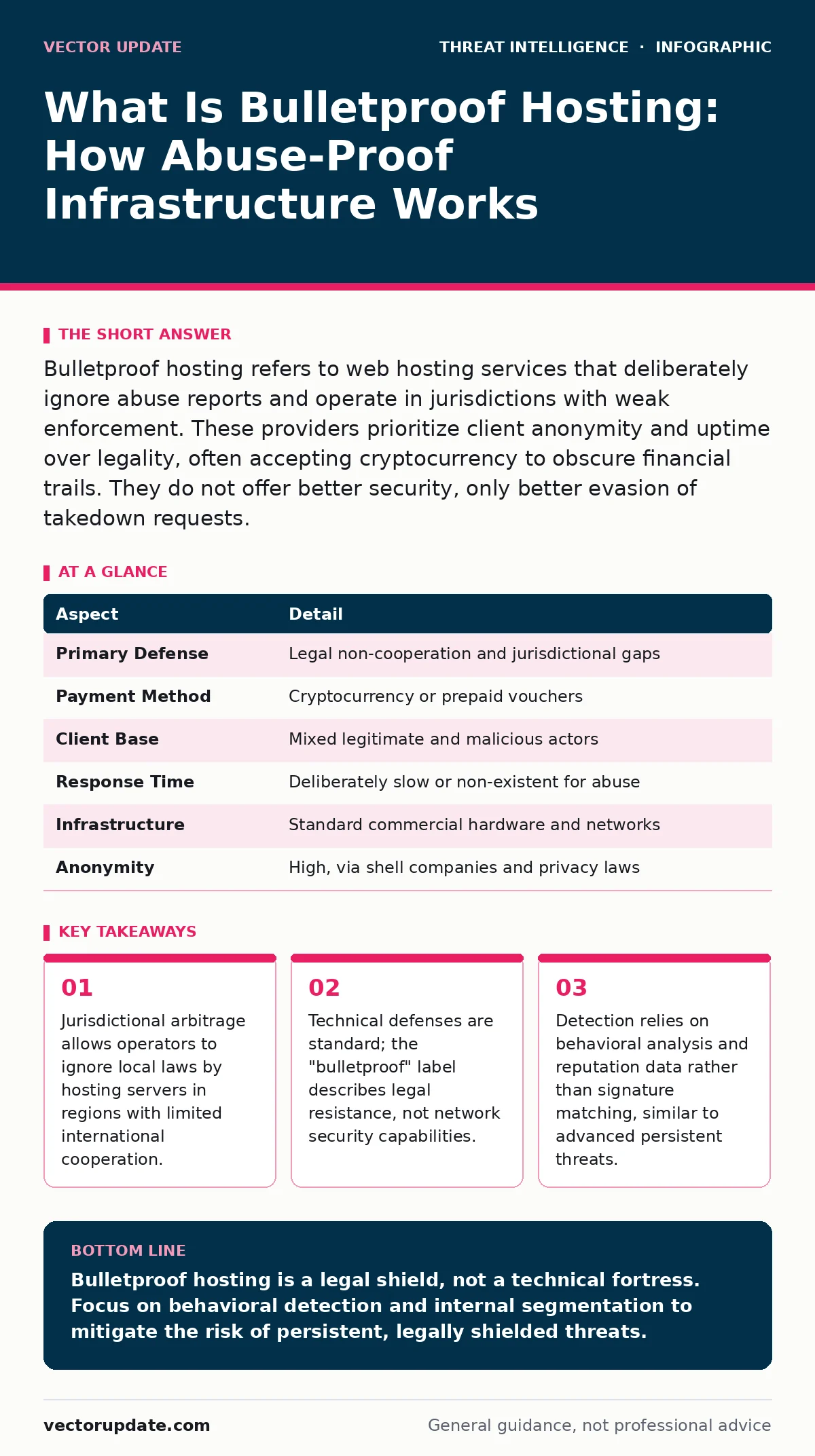
Bulletproof hosting refers to web hosting services that deliberately ignore abuse reports and operate in jurisdictions with weak enforcement. These providers prioritize client anonymity and uptime over legality, often accepting cryptocurrency to obscure financial trails. They do not offer better security, only better evasion of takedown requests.
What Is Bulletproof Hosting
What is bulletproof hosting? It is a commercial service designed to host content or applications that would be illegal or restricted in most other jurisdictions. The provider explicitly states, through silence or marketing, that it will not act on abuse complaints. You are not buying superior firewall rules or advanced intrusion detection. You are buying a refusal to cooperate with law enforcement or copyright holders.
The term does not imply that the infrastructure is immune to cyber espionage or technical compromise. The servers are vulnerable to the same exploits as any other cloud instance. The protection is purely legal and administrative. The host acts as a shield against takedown requests, domain seizures, and financial freezing. This distinction matters because many defenders waste resources trying to hack the hosting provider instead of addressing the legal friction.
Imagine a library that refuses to remove books requested by police. The books are not hidden; they are just not removed. The library owner accepts the risk of fines or closure. This model works because the cost of legal action exceeds the perceived value of the hosted content for the victim.
How The Model Operates
The business model depends on three pillars: jurisdiction, payment, and noise. The provider selects a country with weak cybercrime laws or limited extradition treaties. This creates a legal barrier for victims seeking removal. Payments are accepted in untraceable methods, typically cryptocurrencies. This prevents financial institutions from freezing assets or tracing ownership.
The third pillar is noise. These providers host thousands of clients, including legitimate ones. This creates a haystack effect. When you report abuse, the provider can claim ignorance. They may also use bulletproof hosting to refer to the practice of rapidly moving infrastructure. If a server is seized, the operator migrates to a new IP address within hours. This churn makes traditional blocking methods ineffective.
| Aspect | Detail |
|---|---|
| Primary Defense | Legal non-cooperation and jurisdictional gaps |
| Payment Method | Cryptocurrency or prepaid vouchers |
| Client Base | Mixed legitimate and malicious actors |
| Response Time | Deliberately slow or non-existent for abuse |
| Infrastructure | Standard commercial hardware and networks |
| Anonymity | High, via shell companies and privacy laws |
Who It Affects
You face this problem when defending a network against persistent threats. The attackers use these hosts for command and control servers. They also use them for phishing pages and malware distribution. The impact is not just immediate infection. It is the erosion of your trust in standard remediation. You cannot simply block an IP and move on. The attacker will return on a new IP from the same provider.
This affects your detection logic. You must look for patterns rather than specific indicators. A single malicious IP is easy to block. A cluster of IPs with similar certificate fingerprints or HTML structures is harder. The attackers know this. They use the hosting environment to rotate resources. This forces you to spend more time on triage and less on prevention.
The financial sector is a common target. Fraudsters use these hosts to set up fake banking portals. They change the domain frequently. By the time you discover the fraud, the host has already been taken down or moved. The loss is not recoverable. The hosting provider remains operational, waiting for the next client.
Common Misconceptions
Many people think bulletproof hosting means the server is technically unhackable. This is false. The servers run standard operating systems. They have the same vulnerabilities as any other system. The "bulletproof" label refers to the operator's willingness to ignore complaints, not their ability to repel attacks. Do not assume that because a service is hosted there, it is secure. It is often poorly secured because the operator does not care about client safety.
Another mistake is assuming all offshore hosting is bulletproof. Many legitimate companies host servers overseas for latency or cost reasons. They follow international norms for abuse handling. You must distinguish between a provider that is slow and one that is hostile. Check their abuse contact policy. If it is vague or missing, treat it with suspicion.
Detection Strategies
You cannot rely on static lists to find these threats. The infrastructure changes too quickly. You need dynamic analysis. Use YARA rules to identify malicious payloads regardless of their source IP. These rules match patterns in the code itself. This allows you to detect malware even if the host changes domains.
Monitor for certificate transparency logs. Attackers must register new domains. These registrations are public. You can alert on new certificates issued by known malicious Certificate Authorities or with suspicious common names. This gives you early warning before the campaign starts. It is a proactive measure that shifts your detection left.
Analyze traffic patterns. Look for beaconing behavior. Command and control traffic often has regular intervals. Even if the IP changes, the timing may remain consistent. Use this to cluster related events. This helps you identify the attacker's campaign rather than just their current server.
See also: Cyber Espionage Defined: Tactics, Targets, and Silent Persistence · How Advanced Persistent Threats Move: Step-by-Step Breakdown
Mitigation and Response
When you identify a threat hosted on such infrastructure, containment is your first step. Isolate affected endpoints. Do not rely on the host to take down the service. They will not. You must prevent lateral movement within your network. Use network segmentation to limit the blast radius.
Report the abuse to relevant authorities, but do not expect immediate action. The report creates a record. This can help in future investigations or legal proceedings. It also helps other defenders. Shared intelligence is valuable. Platforms that aggregate abuse data can help you identify patterns across multiple victims.
Update your filtering rules. Block the domains and certificates associated with the campaign. Use threat intelligence feeds to stay current. These feeds often include indicators of compromise from recent incidents. Integrate them into your security tools. This automates the blocking process and reduces manual effort.
Legal And Ethical Limits
You must operate within the law. Do not attempt to hack the hosting provider. This is illegal and counterproductive. It exposes your own infrastructure to risk. It also provides the attacker with evidence of your involvement. Focus on your own network. Secure your endpoints. Harden your perimeter.
Understand the limitations of international law. Cooperation between countries varies. Some jurisdictions are more responsive than others. Build relationships with local cybercrime units. They may have leverage that you do not. They can pressure local internet service providers to cut off connectivity. This is often more effective than direct contact with the host.
Long-Term Resilience
Building resilience against these threats requires a shift in mindset. You cannot eliminate the risk. You can only reduce the impact. Focus on user education. Train your staff to recognize phishing attempts. Even the best technical controls fail if a user clicks a link.
Implement zero trust principles. Verify every request. Do not trust internal traffic by default. This limits the damage if an attacker gains access. Use multi-factor authentication. This adds a layer of security that is difficult to bypass. Even if credentials are stolen, the attacker cannot access your systems.
Regularly review your security posture. Test your defenses with penetration testing. Identify gaps before attackers do. Update your incident response plans. Ensure they cover scenarios involving persistent, legally shielded threats. Practice these plans. Preparedness reduces response time and minimizes damage.
Key takeaways
- Jurisdictional arbitrage allows operators to ignore local laws by hosting servers in regions with limited international cooperation.
- Technical defenses are standard; the "bulletproof" label describes legal resistance, not network security capabilities.
- Detection relies on behavioral analysis and reputation data rather than signature matching, similar to advanced persistent threats.
Bulletproof hosting is a legal shield, not a technical fortress. Focus on behavioral detection and internal segmentation to mitigate the risk of persistent, legally shielded threats.
Frequently asked questions
Can I sue a bulletproof hosting provider?
It is difficult. You must navigate complex international laws and locate the actual owner, who is often hidden behind shell companies. Legal action is costly and time-consuming.
Are all offshore hosts bulletproof?
No. Many legitimate companies host servers overseas for performance. Check their abuse policy and reputation. Legitimate providers will act on valid abuse reports.
Does using VPNs make me a bulletproof host?
No. A VPN hides your identity, but you are still subject to the laws of your jurisdiction. Hosting illegal content on a standard provider via VPN is not bulletproof hosting.
How do I find if a host is bulletproof?
Look for a lack of clear abuse contacts, acceptance of only cryptocurrency, and a history of ignoring complaints. Community forums and threat intelligence feeds often list known providers.
How this guide was produced: written by the Vector Update editorial team with AI assistance, checked against the public references listed below, and reviewed when the facts change. See our editorial policy or report an error.