Cross-Site Scripting (XSS): How It Works and How to Stop It
Cross-site scripting turns your web server into an unwitting delivery mechanism for malicious code that runs directly inside your browser.

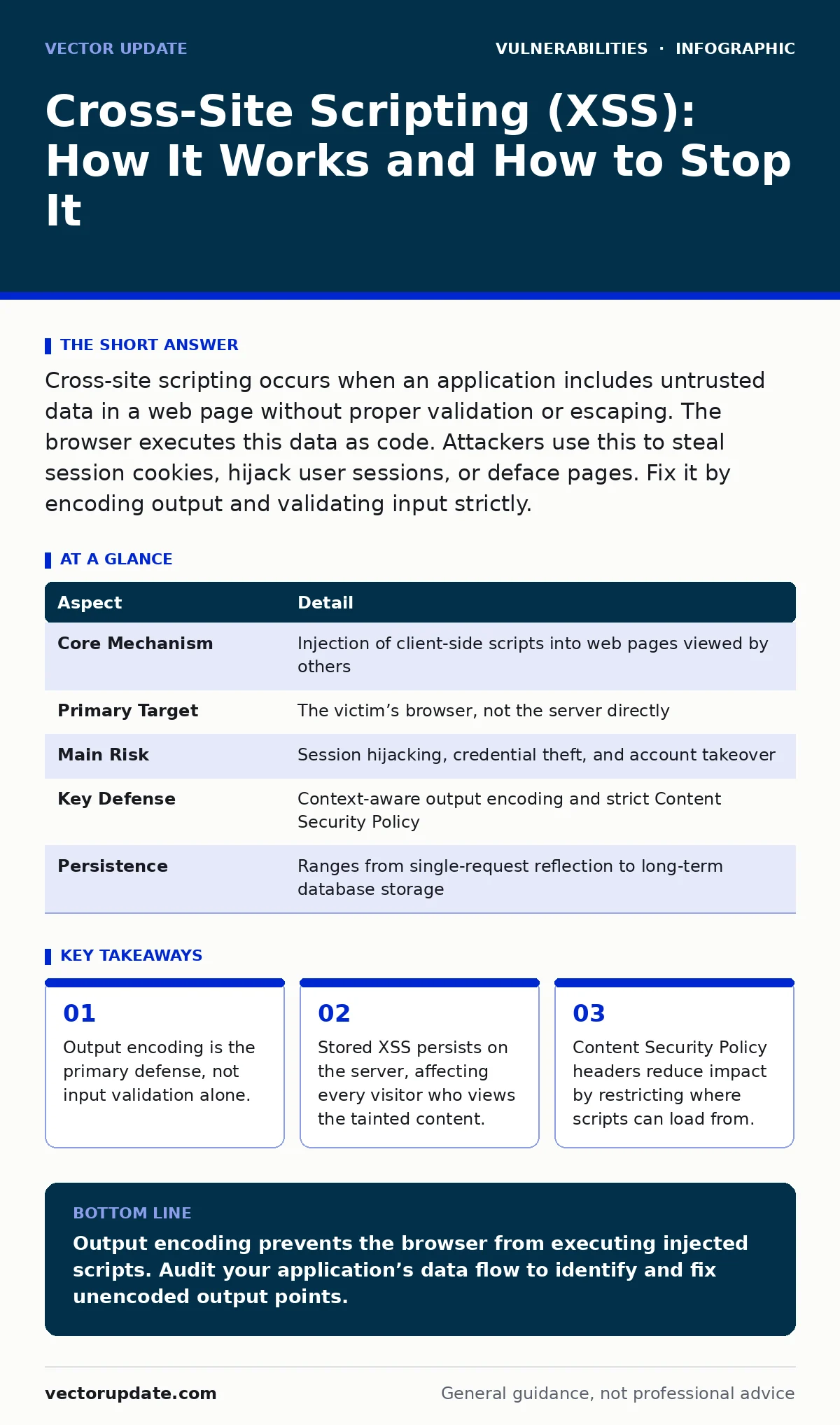
Cross-site scripting occurs when an application includes untrusted data in a web page without proper validation or escaping. The browser executes this data as code. Attackers use this to steal session cookies, hijack user sessions, or deface pages. Fix it by encoding output and validating input strictly.
The Untrusted Printer Analogy
Imagine you run a print shop. A customer hands you a document and asks you to print it. You do not check the ink. You simply feed the paper through the machine. The customer placed a hidden command in the text that tells your printer to erase its own memory. You trusted the customer’s request but failed to sanitize the payload. The printer executed the command because it processed the data without understanding context. Web applications behave the same way when they handle user input.
At a Glance: XSS Fundamentals
| Aspect | Detail |
|---|---|
| Core Mechanism | Injection of client-side scripts into web pages viewed by others |
| Primary Target | The victim’s browser, not the server directly |
| Main Risk | Session hijacking, credential theft, and account takeover |
| Key Defense | Context-aware output encoding and strict Content Security Policy |
| Persistence | Ranges from single-request reflection to long-term database storage |
What Is Cross-Site Scripting?
Cross-site scripting is a vulnerability that allows attackers to inject malicious scripts into web pages. These scripts execute in the browsers of other users who view the affected page. The vulnerability arises when an application takes data from a user and includes it in a response without proper sanitization. The browser cannot distinguish between legitimate application code and the injected script. It treats both as instructions to follow.
The attacker does not need to hack the server. They trick the application into serving their code. This happens because web applications often reflect user input back to the user for convenience. A search box shows your query. A comment section displays your text. If the application fails to encode this data, the browser interprets HTML tags and JavaScript functions within it. You become the victim of your own application’s trust in raw data.
Common Forms of Attack
Developers categorize cross-site scripting into three primary types. Each type has different characteristics and remediation paths. Understanding the distinction helps you prioritize your testing efforts.
Reflected XSS occurs when the malicious script is part of the request itself. The server reflects the payload back to the browser in an error message, search result, or custom page. The victim usually clicks a specially crafted link. The script runs once and then disappears. It requires social engineering to trick the user into clicking the link.
Stored XSS happens when the application saves the malicious script to a database. The script persists on the server. Every user who views the affected page executes the script. This form is more dangerous because it affects many victims without further attacker involvement. A single comment on a blog post can compromise thousands of readers.
DOM-based XSS is a client-side issue. The application’s JavaScript reads data from the URL or another source and writes it to the DOM without encoding. The server never sees the payload. The vulnerability exists entirely in the front-end code. This type often slips past traditional server-side scanners.
Who Actually Gets Affected?
The immediate victim is the user whose browser executes the script. The attacker gains access to whatever the user’s browser can access. This includes session cookies, local storage, and clipboard data. If the user is logged into a banking application, the attacker can impersonate them. The application owner suffers reputational damage and potential liability.
The server itself usually remains uncompromised. The script runs in the user’s context. The attacker cannot directly access server files or databases through standard cross-site scripting. They rely on the user’s existing privileges. This makes it a client-side attack vector that leverages the server’s trust in the user.
What People Usually Get Wrong
Many teams believe input validation stops cross-site scripting. They block known bad patterns at the entry point. This approach fails because attackers constantly find new ways to bypass filters. Encoding output is the reliable defense. Input validation is a helpful layer but never sufficient on its own.
Another common error is assuming only text fields are vulnerable. Attackers inject scripts via hidden form fields, HTTP headers, and file names. If your application uses any of these values in a response, you must encode them. Context matters. A value safe in an HTML body might be dangerous in a JavaScript variable or a URL attribute.
Reducing the Risk
Implement defense in depth. Rely on multiple layers to catch errors. Start with context-aware output encoding. Use a library that understands the specific context of the data. HTML entities differ from JavaScript string escaping. URL encoding differs from both. A generic escape function will fail in complex contexts.
Enforce strict Content Security Policy headers. These headers tell the browser which sources are allowed to load scripts. A strict policy blocks inline scripts and eval() calls. This limits the damage even if an injection occurs. The browser will refuse to execute the malicious code.
Maintain a regular schedule of browser updates. Browsers patch rendering engine flaws that attackers exploit. Old browsers lack modern security features like automatic output encoding in certain contexts. Encourage users to keep their clients current.
Integration With Broader Security
Cross-site scripting often connects to other weaknesses. A broken access control might allow an attacker to inject scripts into admin-only pages. This expands the impact significantly. Review your IT asset inventory to ensure you track all components that handle user input.
Third-party libraries can introduce vulnerabilities. If a library handles user input and outputs it to the DOM, it might be vulnerable. Monitor your vulnerable third-party libraries closely. Apply patches quickly.
Effective risk-based vulnerability management prioritizes these fixes. Not all cross-site scripting risks are equal. A stored script on a login page is higher risk than a reflected script on a public footer. Assess the impact and likelihood before allocating resources.
The Hidden Cost of Trust
Applications trust users implicitly. This trust enables functionality but creates risk. Every time you display user data, you create an attack surface. The cost of ignoring this is session theft and data breach. The cost of fixing it is development time and careful code review.
You must balance usability with security. Strict encoding might break rich text editors. You need to find a safe way to allow formatting without allowing scripts. This often requires specialized libraries or white-listing specific tags. Do not try to build this logic yourself. Use established, well-tested components.
Regularly audit your codebase for these patterns. Look for places where data flows from input to output without transformation. These are your high-risk areas. Fix them before they become incidents.
Key takeaways
- Output encoding is the primary defense, not input validation alone.
- Stored XSS persists on the server, affecting every visitor who views the tainted content.
- Content Security Policy headers reduce impact by restricting where scripts can load from.
- Reflected XSS triggers immediately in the user's current browser session.
Output encoding prevents the browser from executing injected scripts. Audit your application’s data flow to identify and fix unencoded output points.
Frequently asked questions
Does HTTPS prevent cross-site scripting?
No. HTTPS encrypts the connection between the browser and server. It does not validate or encode the content being transmitted. Attackers can still inject scripts over secure connections.
Can a firewall stop cross-site scripting?
A web application firewall can block some known attack patterns. It is not a complete solution. Attackers can bypass filters, and legitimate input might trigger false positives. Encoding output is more reliable.
Why is input validation not enough?
Input validation tries to block bad data. Attackers find ways to bypass these rules. Output encoding ensures that any data displayed to the user is treated as text, not code, regardless of its origin.
How do I know if I have stored XSS?
Test by submitting script tags to every input field. Check if the script executes when you view the page later. Use automated scanners and manual testing to find these persistent vulnerabilities.
How this guide was produced: written by the Vector Update editorial team with AI assistance, checked against the public references listed below, and reviewed when the facts change. See our editorial policy or report an error.