Pre-Authentication Vulnerabilities Explained: Risks Before Login
Attackers exploit pre-authentication flaws to execute code or steal data without valid credentials, bypassing the security boundary entirely.

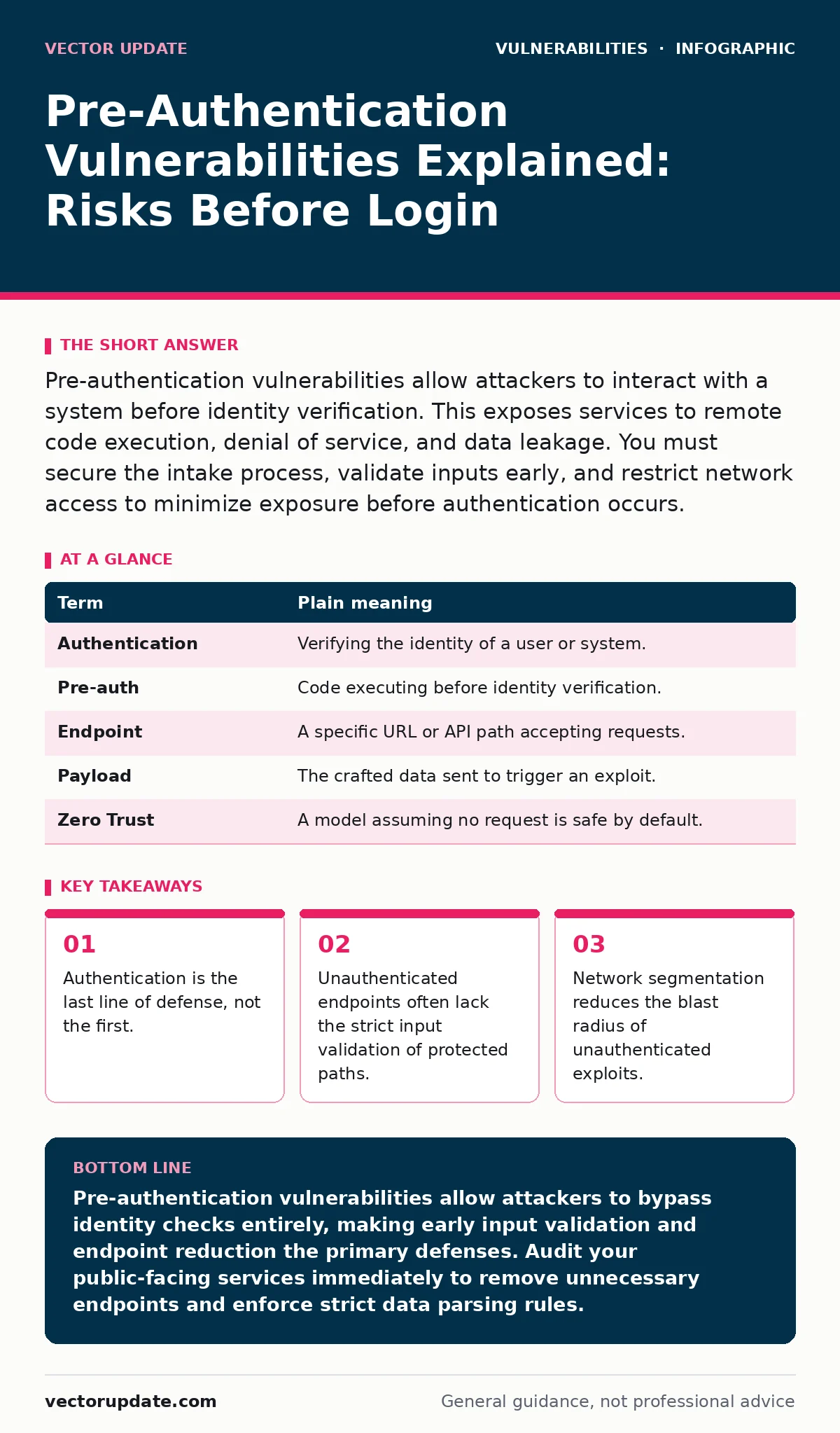
Pre-authentication vulnerabilities allow attackers to interact with a system before identity verification. This exposes services to remote code execution, denial of service, and data leakage. You must secure the intake process, validate inputs early, and restrict network access to minimize exposure before authentication occurs.
The Open Door Analogy
Imagine a building with a heavy steel door at the front. This door requires a key card to open. Behind it lies the secure office where your sensitive files live. Now imagine the building has a side entrance for deliveries. This side door has no lock. Anyone can walk in, place a bomb in the hallway, and leave. The steel door is useless against this threat. The attacker never needed the key card. Pre-authentication vulnerabilities are that unlocked side door. They exist in the code that handles requests before the system checks who is sending them.
Defining the Scope
The term pre-authentication refers to any code path that executes before the server verifies the user's identity. This includes initial handshake protocols, health check endpoints, and public-facing APIs. Attackers target these areas because they require zero credentials. You cannot block an attacker with a password policy if the exploit lives in the greeting. The vulnerability exists because the system assumes the initial request is harmless or trustworthy. This assumption fails when attackers send crafted data that triggers unexpected behavior in the parsing logic.
Key Terms for Clarity
Understanding the mechanics requires precise vocabulary. Confusing these terms leads to misconfigured defenses. Use this table to align your mental model with the technical reality.
| Term | Plain meaning |
|---|---|
| Authentication | Verifying the identity of a user or system. |
| Pre-auth | Code executing before identity verification. |
| Endpoint | A specific URL or API path accepting requests. |
| Payload | The crafted data sent to trigger an exploit. |
| Zero Trust | A model assuming no request is safe by default. |
Common Points of Confusion
Many administrators believe that hiding an endpoint makes it secure. This is incorrect. Attackers scan for common default paths regardless of visibility. Another confusion is mixing up business logic flaws with pre-auth bugs. Business logic errors often require valid sessions to exploit. Pre-auth bugs do not. If an attacker can crash the service by sending a specific packet to port 80, that is a pre-auth issue. It matters less if the web application behind it requires complex login flows.
Hidden Costs and Trade-Offs
Securing pre-auth paths introduces latency. Every request must be inspected before the system knows if the sender is friendly. This adds processing overhead. You might see slower response times for legitimate users. The trade-off is between performance and security surface area. Reducing the number of exposed endpoints lowers the risk but can break integration tools. You must balance accessibility with restriction. Disabling unnecessary features is the most effective control, but it requires understanding which features are truly needed.
Real-World Attack Patterns
Attackers often use these vulnerabilities for initial access. They might send a request that causes the server to execute arbitrary code. This is remote code execution. They might send data that consumes all available memory, causing a denial of service. This is resource exhaustion. They might exploit a flaw in how the server parses JSON or XML. This is deserialization. These attacks succeed because the server processes the data before checking if the sender is authorized. The damage occurs before the security team even sees a login attempt.
Mitigation Strategies
You cannot patch every potential flaw. You must reduce the attack surface. Start by inventorying all public-facing endpoints. Remove any that are not strictly necessary. For the ones you keep, implement strict input validation. Reject malformed requests immediately. Use a web application firewall to filter known attack patterns. Segment your network so that compromised services cannot reach internal assets. This limits the damage even if an exploit succeeds. Refer to your IT asset inventory to ensure you know what is exposed.
Practical Verification Steps
You can test your defenses without specialized tools. Follow these steps to identify weak points.
- Map all public endpoints. List every URL that accepts external traffic.
- Check for default credentials. Many systems use admin/admin by default.
- Test input validation. Send oversized or malformed data to public forms.
The Role of Maintenance
Vulnerabilities appear when libraries are outdated. Attackers publish exploits for known issues in popular frameworks. Keeping your software updated is critical. This includes the operating system, the web server, and the application code. Neglecting updates leaves known doors open. Regular patching closes these doors before attackers can find them. It is a boring task, but it prevents the most common breaches.
Connection to Other Flaws
Pre-auth vulnerabilities often overlap with other issues. For instance, time-of-check to time-of-use (TOCTOU) bugs can occur in file handling before authentication. If the system checks permissions before verifying identity, it fails. Similarly, cross-site scripting (XSS) can sometimes be triggered in pre-auth pages if input is reflected unsafely. Understanding Python pickle deserialization risks is relevant if your stack uses Python for data handling. These are distinct concepts, but they share the same root cause: trusting unverified input.
Final Thoughts on Exposure
The goal is not to eliminate all pre-auth code. Some functionality must be public. The goal is to minimize the code that runs before authentication. Every line of code before the login check is a potential entry point. Review your architecture regularly. Ask if each public endpoint is necessary. If it is not, remove it. If it is, harden it. Security is a continuous process of reduction and validation.
Key takeaways
- Authentication is the last line of defense, not the first.
- Unauthenticated endpoints often lack the strict input validation of protected paths.
- Network segmentation reduces the blast radius of unauthenticated exploits.
Pre-authentication vulnerabilities allow attackers to bypass identity checks entirely, making early input validation and endpoint reduction the primary defenses. Audit your public-facing services immediately to remove unnecessary endpoints and enforce strict data parsing rules.
Frequently asked questions
Are pre-authentication vulnerabilities only found in web applications?
No, they exist in any service accepting network connections, including databases, APIs, and IoT devices.
Can a web application firewall stop all pre-auth attacks?
No, WAFs block known patterns but cannot stop novel exploits targeting custom business logic.
How do I know if an endpoint is pre-auth?
If the endpoint accepts a request and processes it before returning a 401 Unauthorized error, it is pre-auth.
Should I disable all public APIs?
Only disable APIs that are not required for external functionality. Internal APIs should be network-restricted.
How this guide was produced: written by the Vector Update editorial team with AI assistance, checked against the public references listed below, and reviewed when the facts change. See our editorial policy or report an error.