Unsafe YAML Deserialization: Response and Recovery Steps
YAML parsers often execute arbitrary code when processing tags, turning data configuration into a remote execution vector that bypasses standard application logic checks.

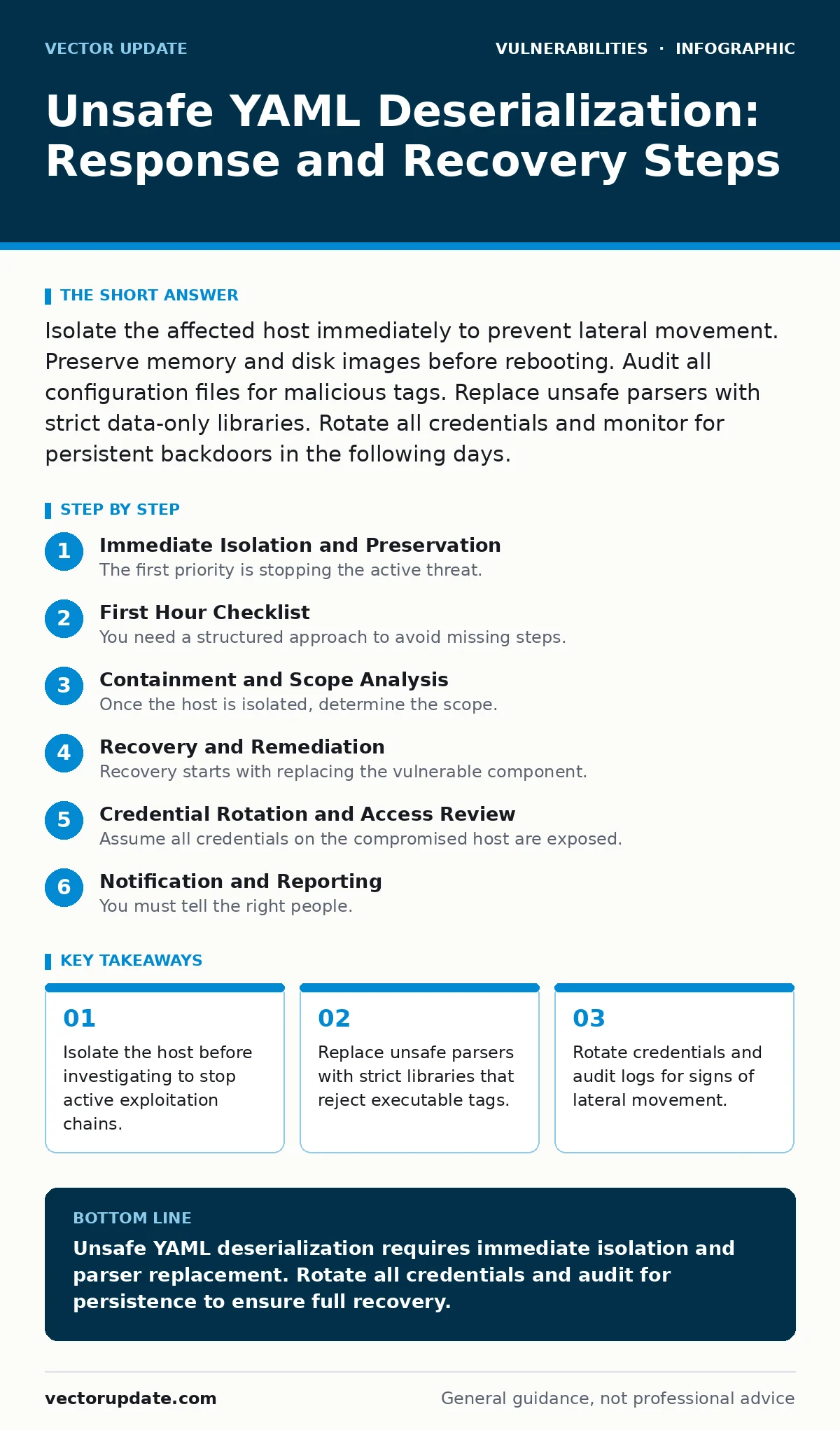
Isolate the affected host immediately to prevent lateral movement. Preserve memory and disk images before rebooting. Audit all configuration files for malicious tags. Replace unsafe parsers with strict data-only libraries. Rotate all credentials and monitor for persistent backdoors in the following days.
Immediate Isolation and Preservation
The first priority is stopping the active threat. Unsafe YAML deserialization allows attackers to instantiate arbitrary objects within the application runtime. This mechanism often executes system commands directly. You must cut the infected host from the network immediately. Physical disconnection or disabling the network interface card works best. Do not shut down the machine. Shutting down destroys volatile memory evidence. Memory contains the active process tree and loaded libraries. These artifacts prove what code ran and when.
Create a forensic image of the disk. Use a write-blocker if possible to prevent accidental modification. Capture the memory dump using standard forensic tools. Document the current time and your actions. This timeline matters for later analysis. Do not attempt to "fix" the vulnerability yet. Stabilization comes after containment. Your goal is to freeze the state of the system for analysis.
First Hour Checklist
You need a structured approach to avoid missing steps. Follow this checklist to ensure you cover the immediate response requirements.
- Disconnect the host from the network.
- Capture a full memory dump.
- Create a bit-for-bit disk image.
- Record the exact time of isolation.
- Identify the compromised service or application.
- Notify the incident response team.
- Preserve network logs from the gateway.
Network logs are vital. They show the external IP addresses that connected to the service. You will need these for attribution and blocking. Save the application logs too. Look for unusual spikes in CPU or memory usage. These spikes often correlate with the deserialization event. The attacker might have used the vulnerability to mine cryptocurrency or launch further attacks.
Containment and Scope Analysis
Once the host is isolated, determine the scope. Did the attacker move laterally? Check internal network traffic logs. Look for connections from the compromised host to other servers. Pay attention to database servers and internal APIs. The attacker likely used the initial access to gain higher privileges. Check for new user accounts created recently. Look for modified scheduled tasks or cron jobs. These are common persistence mechanisms.
Imagine the attacker used the YAML payload to download a second-stage payload. That payload might reside in a temporary directory. Search for files created around the time of the incident. Check for new binaries in system directories. Compare file hashes against known good baselines. If you have a baseline, this step is faster. If not, you must manually review recent changes. This process is tedious but necessary.
Recovery and Remediation
Recovery starts with replacing the vulnerable component. The root cause is usually a permissive YAML parser. Many languages have libraries that allow arbitrary object instantiation. You must replace these with strict parsers. Strict parsers only allow basic data types. They reject tags that trigger code execution. This change requires code modification. You cannot fix this with a configuration tweak alone. The library itself must be swapped or updated.
Review your deployment pipeline. How did the vulnerable version get deployed? Was there a security scan? If not, add one. Static analysis tools can detect unsafe deserialization patterns. Integrate these tools into your continuous integration process. This prevents future regressions. Do not return the server to production until the code is fixed and tested. Testing must include malicious payloads to verify the fix.
Credential Rotation and Access Review
Assume all credentials on the compromised host are exposed. The attacker had code execution. They could read environment variables. They could access configuration files. Rotate all passwords, API keys, and tokens. This includes database passwords and service account credentials. Do not reuse old passwords. Generate new, strong credentials. Update the configuration files with the new values. Restart the services to apply the changes.
Check for new SSH keys or authorized users. Attackers often add their own keys for persistent access. Remove any keys you do not recognize. Audit the sudoers file or local administrators group. Look for new entries. Remove unauthorized users. This step is often overlooked. Attackers know that defenders focus on the code. They hide in the user accounts.
See also: How Breach Notification Laws Force Better Security Decisions
Notification and Reporting
You must tell the right people. Inform your management team. Provide a factual summary. Avoid technical jargon in the initial report. State what happened, what was contained, and what is next. Notify legal and compliance teams. They determine if regulatory reporting is required. This depends on the data stored on the server. If personal data was exposed, you may have legal obligations.
Inform your users if their data was at risk. Transparency builds trust. Be honest about the timeline. Do not promise complete protection. Explain the steps taken to prevent recurrence. This includes the parser update and credential rotation. Keep a log of all communications. This log serves as evidence of due diligence. It shows you acted responsibly.
Preventing Recurrence
To stop a repeat, you need architectural changes. Do not trust external input. Validate all YAML before parsing. Use allowlists for expected tags. Reject any input that contains unexpected structures. This is similar to preventing cross-site scripting (XSS) by sanitizing output. You must treat input as hostile.
Consider using a different configuration format. JSON or XML may be safer if parsed strictly. They do not have the same object instantiation risks. If you must use YAML, enforce schema validation. The schema defines the allowed structure. The parser rejects anything outside the schema. This adds a layer of defense. It does not replace secure coding, but it helps.
Monitor for similar vulnerabilities. Subscribe to security advisories for your libraries. Patch promptly. Do not wait for a breach. Proactive maintenance reduces risk. This approach applies to other issues like broken access control. You must consistently enforce least privilege.
Long-Term Security Posture
Security is a continuous process. This incident reveals gaps in your tooling. Improve your monitoring. Set up alerts for unusual process creation. Detect when a web server spawns a shell. This indicates code execution. Respond faster next time.
Train your developers. They need to understand the risks of deserialization. It is not just a library issue. It is a design issue. Encourage secure coding practices. Review code for unsafe patterns. Use peer reviews. Catch these issues before deployment. This reduces the attack surface.
Consider how this relates to firmware updates. If your infrastructure relies on embedded devices, ensure they are also secure. Weaknesses in one layer can compromise the whole system. Maintain a holistic view. Security is not a single product. It is a set of practices. Apply them consistently.
Check for silent security patches. Some vendors release fixes without fanfare. You might miss them. Subscribe to mailing lists. Read release notes. Stay informed. This diligence prevents exploitation of known issues. It is a simple but effective habit.
Key takeaways
- Isolate the host before investigating to stop active exploitation chains.
- Replace unsafe parsers with strict libraries that reject executable tags.
- Rotate credentials and audit logs for signs of lateral movement.
Unsafe YAML deserialization requires immediate isolation and parser replacement. Rotate all credentials and audit for persistence to ensure full recovery.
Frequently asked questions
Can I fix unsafe YAML deserialization with a firewall rule?
No, firewalls cannot inspect the application logic inside the payload. You must update the code to use a strict parser.
How do I know if my YAML parser is vulnerable?
Check if it supports arbitrary object instantiation or tag execution. Most default configurations in older libraries are unsafe.
Should I delete the logs after the incident?
Never delete logs. They are critical for forensic analysis and legal compliance. Archive them securely.
Is JSON safer than YAML for configuration?
JSON is generally safer if parsed strictly, as it lacks the object instantiation features of YAML.
How this guide was produced: written by the Vector Update editorial team with AI assistance, checked against the public references listed below, and reviewed when the facts change. See our editorial policy or report an error.