Business Continuity Planning: Fix 6 Common Misunderstandings
Most organizations treat business continuity as a backup strategy, ignoring the operational logic required to keep services running during a sustained cyber incident.

Business continuity planning is not a backup procedure or a disaster recovery checklist. It is the operational logic that keeps critical services running during a sustained incident. You must define manual workarounds, prioritize data integrity over availability, and test communication channels that function when primary networks fail.
Misreading: Business continuity is just a fancy backup strategy
Correct reading: Backups restore data; business continuity maintains operations. A backup is a static copy of information stored offline or in a separate environment. Business continuity planning defines how you deliver service while that data remains inaccessible or compromised. If you rely solely on backups, you assume you can stop work until the data returns.
This assumption fails during ransomware events where attackers encrypt backups or hold data hostage for weeks. You need a process that allows limited operations without the primary dataset. This process often involves degraded service levels or manual tracking methods. Backup solutions address data loss. Continuity plans address service interruption. The two are distinct disciplines with different success metrics.
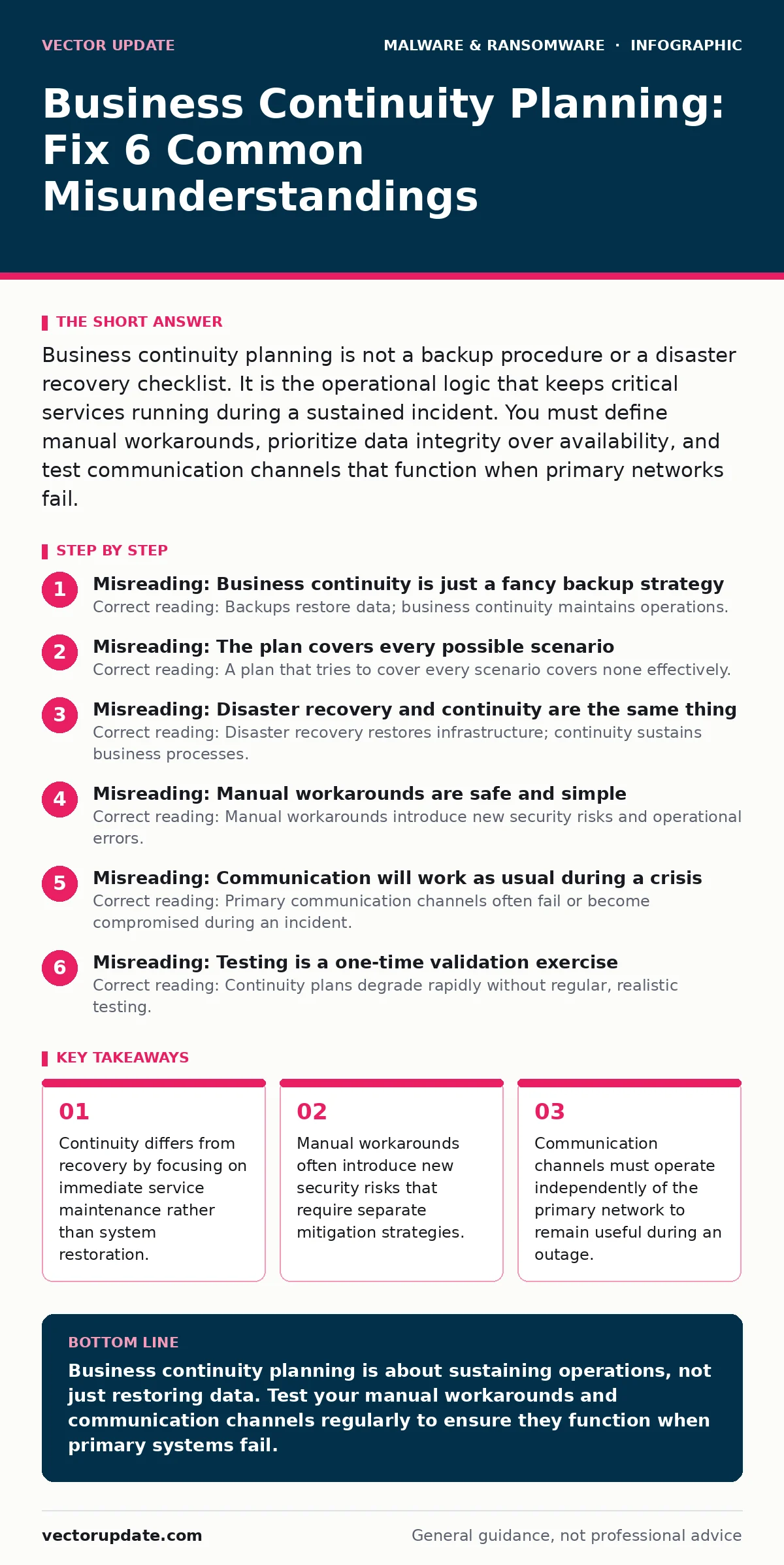
Misreading: The plan covers every possible scenario
Correct reading: A plan that tries to cover every scenario covers none effectively. You cannot predict every attack vector or failure mode. Attempting to do so creates a document so complex that no one can execute it under pressure. Focus on critical business functions instead of hypothetical threats. Identify the 3 to 5 services that generate revenue or maintain safety.
Build continuity procedures for those specific services. Ignore low-value functions during the initial response. This focus allows you to allocate resources to the areas that matter most. A narrow plan is easier to test and update. It reduces decision fatigue during a crisis. Broad plans often contain contradictions that confuse responders.
Misreading: Disaster recovery and continuity are the same thing
Correct reading: Disaster recovery restores infrastructure; continuity sustains business processes. Disaster recovery plans focus on bringing servers, networks, and applications back online. They deal with hardware, software, and connectivity. Business continuity planning deals with people, processes, and customer expectations.
You can have a fully restored network but still fail to continue business if staff do not know how to process orders manually. Disaster recovery is technical. Continuity is operational. Many organizations invest heavily in disaster recovery while neglecting the human workflows required to keep the business alive. This imbalance leads to restored systems that sit idle because staff are unsure how to proceed.
Misreading: Manual workarounds are safe and simple
Correct reading: Manual workarounds introduce new security risks and operational errors. When systems go down, staff often switch to spreadsheets, email, or paper forms. These methods lack the access controls and audit trails of the primary system. An attacker who has compromised the network may still intercept emails or access shared drives.
You must treat manual processes as a separate security domain. Define strict rules for handling sensitive data during manual operations. Limit the number of people authorized to perform critical tasks. Verify data integrity at multiple points. Manual processes are prone to human error. A single typo in a spreadsheet can cause significant downstream issues. Do not assume that "offline" means "secure."
Misreading: Communication will work as usual during a crisis
Correct reading: Primary communication channels often fail or become compromised during an incident. Ransomware may encrypt email servers or disrupt internal messaging platforms. Phishing campaigns often target communication channels to spread malware further. You need an out-of-band communication method that operates independently of the primary network.
This could be a dedicated mobile network, a satellite phone, or a secure messaging app on personal devices. Test this channel regularly. Ensure all key personnel have access to it. Define clear escalation paths and message templates. Ambiguous communication during a crisis leads to delayed decisions and conflicting actions. A broken communication chain is as damaging as a broken server.
See also: How Breach Notification Laws Force Better Security Decisions
Misreading: Testing is a one-time validation exercise
Correct reading: Continuity plans degrade rapidly without regular, realistic testing. A plan that sits in a drawer for two years is likely obsolete. Staff turnover, process changes, and technology updates render static documents useless. You must test the plan frequently. Use tabletop exercises to walk through scenarios without executing them.
Use functional exercises to perform actual manual workarounds. Test the communication channels under load. Verify that contact information is current. Testing reveals gaps that writing never finds. It builds muscle memory for the response team. It identifies dependencies you did not know existed. A plan that has never been tested is a theory, not a strategy.
Misreading: The IT department owns the entire plan
Correct reading: Business continuity is a cross-functional responsibility. IT can restore systems, but they cannot define business priorities. Department heads must identify which processes are critical. Legal teams must define compliance requirements. Human resources must manage staff availability and safety. Executive leadership must make final decisions on resource allocation.
An IT-centric plan often misses critical business nuances. It may restore systems in the wrong order or neglect customer communication protocols. Assign clear roles and responsibilities across all departments. Ensure each department has a point of contact for continuity planning. This distributed ownership ensures the plan reflects the reality of the business, not just the technology stack.
Misreading: Cloud migration eliminates the need for continuity planning
Correct reading: Cloud environments introduce new dependencies and failure modes. Cloud providers offer high availability, but they are not immune to outages, misconfigurations, or account compromises. If your cloud identity provider goes down, you may lose access to all services. If a misconfiguration exposes data, you must respond immediately.
Cloud continuity planning requires different techniques than on-premises planning. You must understand provider dependencies and regional failures. You need automated failover mechanisms and rigorous access controls. Assuming the cloud handles continuity is a dangerous misconception. The cloud shifts the responsibility for infrastructure to the provider, but it shifts the responsibility for application and data continuity to you.
Key takeaways
- Continuity differs from recovery by focusing on immediate service maintenance rather than system restoration.
- Manual workarounds often introduce new security risks that require separate mitigation strategies.
- Communication channels must operate independently of the primary network to remain useful during an outage.
Business continuity planning is about sustaining operations, not just restoring data. Test your manual workarounds and communication channels regularly to ensure they function when primary systems fail.
Frequently asked questions
How often should I test my business continuity plan?
Test the plan at least twice a year. Use tabletop exercises quarterly to keep staff familiar with procedures. Perform full functional tests annually to validate manual workarounds and communication channels.
What is the difference between a business impact analysis and a risk assessment?
A risk assessment identifies potential threats and vulnerabilities. A business impact analysis determines the financial and operational consequences of those threats materializing. You need both to prioritize continuity efforts.
Should I include third-party vendors in my continuity plan?
Yes. Identify critical vendors and understand their continuity capabilities. If a vendor fails, it impacts your operations. Establish alternative suppliers or manual processes for critical dependencies.
How do I handle remote workers in a continuity plan?
Define how remote workers access systems and communicate during an incident. Ensure they have secure devices and alternative communication methods. Test remote access procedures regularly.
How this guide was produced: written by the Vector Update editorial team with AI assistance, checked against the public references listed below, and reviewed when the facts change. See our editorial policy or report an error.