Voice Cloning Scams: How Attackers Steal Your Identity
Attackers need only seconds of your audio to create a convincing voice replica that bypasses traditional security checks.
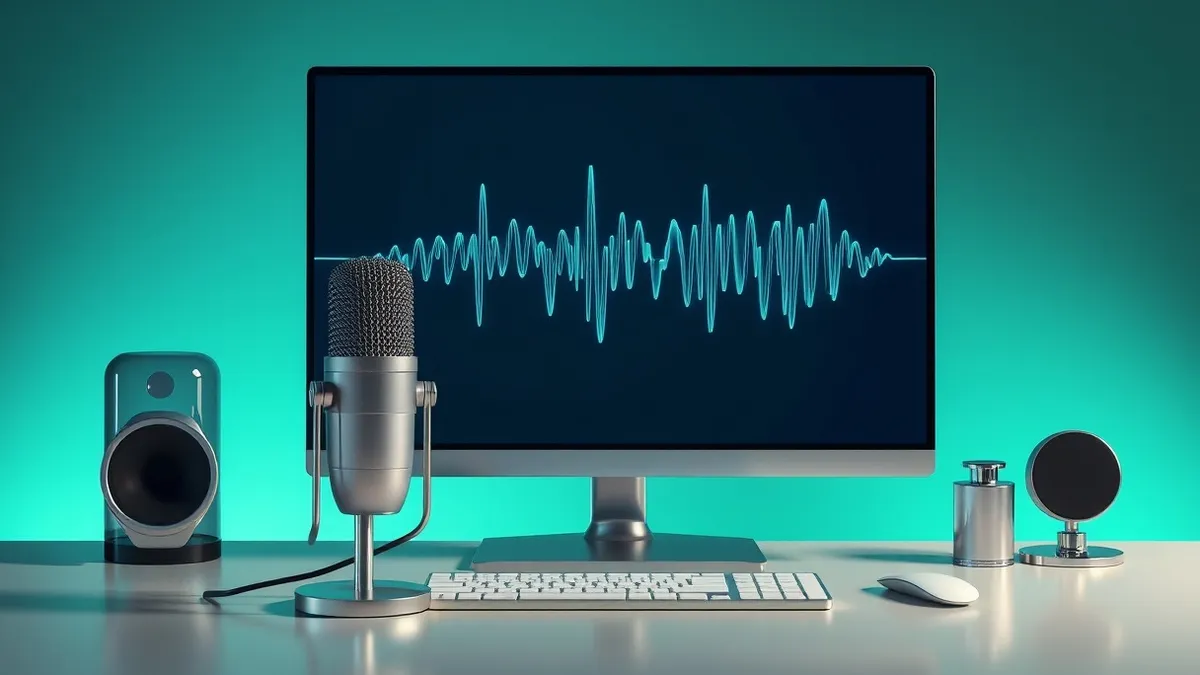
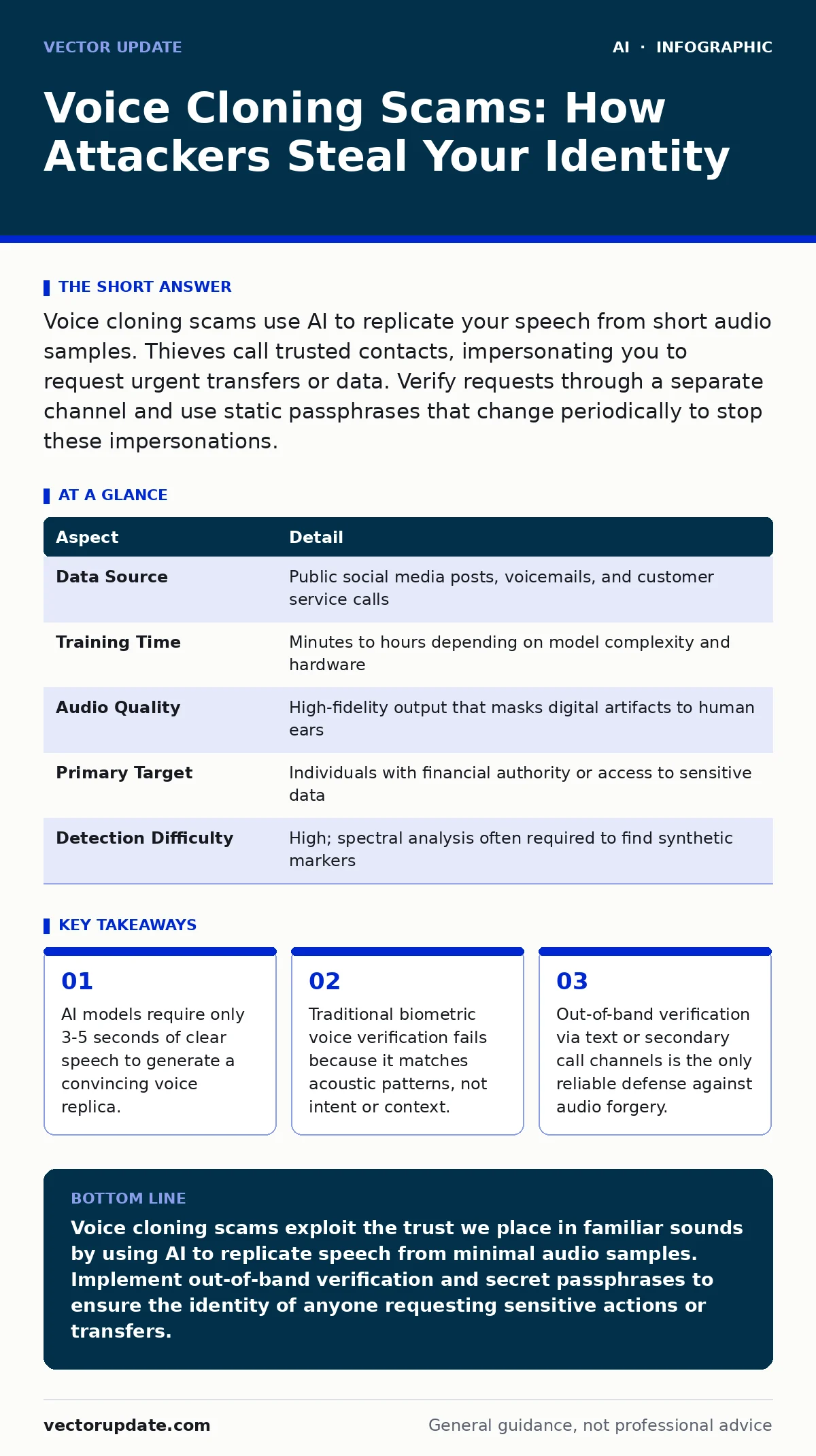
Voice cloning scams use AI to replicate your speech from short audio samples. Thieves call trusted contacts, impersonating you to request urgent transfers or data. Verify requests through a separate channel and use static passphrases that change periodically to stop these impersonations.
Understanding the Threat
Imagine a friend calling you in a panic, asking for money to cover an emergency. The voice sounds exactly right, including the specific cadence and slight hesitation they use when stressed. Now imagine that voice is not your friend. It is a synthetic audio file generated by software that analyzed a few seconds of their public social media video.
This is the core mechanism behind voice cloning scams. The technology removes the need for long recordings or physical access to the victim. Attackers harvest audio from platforms where users share daily life updates. They feed these clips into machine learning models that map the unique acoustic signature of the speaker. The result is a digital twin that can speak any words the attacker chooses.
| Aspect | Detail |
|---|---|
| Data Source | Public social media posts, voicemails, and customer service calls |
| Training Time | Minutes to hours depending on model complexity and hardware |
| Audio Quality | High-fidelity output that masks digital artifacts to human ears |
| Primary Target | Individuals with financial authority or access to sensitive data |
| Detection Difficulty | High; spectral analysis often required to find synthetic markers |
How the Technology Works
The process relies on two distinct stages: extraction and synthesis. First, the attacker isolates the voice from background noise. Modern algorithms separate the speaker’s frequency from ambient sounds like traffic or music. This cleaned audio serves as the training data. Second, the system builds a neural network model. This model learns the speaker’s pitch, tone, and pronunciation habits. It does not memorize the original sentences.
It learns the physical characteristics of the vocal cords and mouth shape. Once trained, the model acts as a generator. You provide text, and it produces audio. The output matches the original speaker’s voice profile. This means the cloned voice can say things the real person never said. It can speak languages the original speaker does not know. The fidelity is sufficient to trick casual listeners. It often fools automated voice recognition systems that rely on static biometric templates.
Who Faces the Highest Risk
This threat affects anyone with a digital footprint that includes audio. However, certain roles face higher exposure. Executives and finance officers are prime targets because they authorize payments. Their voices are often heard in company meetings or public interviews. Small business owners also face significant risk. They frequently handle transactions personally and may not have formal verification protocols. Family members are targeted through social engineering.
Attackers pose as relatives in distress. The emotional urgency overrides logical checks. Organizations with remote workforces are particularly vulnerable. They rely on phone calls and video conferences for critical decisions. The lack of physical presence makes it harder to verify identity. If your voice is available online, you are a potential target. The barrier to entry for attackers is low. Software tools are widely available and require minimal technical skill to operate.
What People Usually Get Wrong
Many users believe that voice biometrics provide absolute security. They assume that if the system recognizes the voice, the person is who they claim to be. This is a fundamental error. Voice is a characteristic, not a credential. It can be copied, unlike a physical key or a hardware token. Another common mistake is relying on content verification. Listeners try to detect errors in grammar or tone.
Synthetic voices are fluent and can mimic emotional states. They do not stumble over words. They do not sound robotic. The human ear is poor at distinguishing high-quality synthetic audio from real speech. You cannot trust your hearing alone. The assumption that "only I can sound like me" is false in the age of generative AI. Security must shift from verifying the voice to verifying the request itself.
Defending Against Audio Forgery
You must implement verification steps that do not rely on audio. The most effective method is out-of-band verification. When you receive a request for money or data via phone, hang up. Call the person back using a known, trusted number. Do not use the number that called you. Attackers can spoof caller ID. Use a secondary channel such as text or email to confirm the request.
Establish a challenge-response protocol with trusted contacts. Choose a word or phrase that is difficult to guess. Change this passphrase regularly. If the caller cannot provide the correct response, treat the call as fraudulent. This adds a layer of security that voice cloning cannot bypass. The cloned voice does not know the secret phrase. This method requires coordination but stops the scam at the source.
Organizational Security Measures
Companies must update their security policies to account for synthetic media. Relying on voice recognition for access control is no longer sufficient. Implement multi-factor authentication for all financial transactions. Require secondary approval for large transfers. Train staff to recognize the signs of social engineering. Emphasize that urgency is a common tactic. Attackers try to rush victims into acting without thinking. Slow down the process.
Introduce mandatory delays for high-value requests. Review the responsible AI practices to ensure internal tools are secure. Consider how insecure AI plugins and agents might expose voice data. Ensure that customer service recordings are stored securely. Prevent unauthorized access to these archives. Regular audits of data retention policies help reduce the amount of voice data available for theft.
The Role of Detection Tools
Technical detection is improving but remains imperfect. Algorithms can analyze audio for spectral irregularities. They look for patterns that human ears miss. These tools check for consistent noise floors and unnatural silence gaps. However, they are not foolproof. Attackers continuously refine their models to remove these artifacts. Detection should be a secondary layer, not the primary defense. It can flag suspicious calls for human review.
It cannot guarantee safety on its own. Combine technical tools with procedural controls. Use machine learning for fraud detection to monitor transaction patterns. If a request deviates from normal behavior, trigger additional checks. This hybrid approach provides better protection than any single method. Stay informed about deepfake detection advancements. The technology evolves rapidly. What works today may fail tomorrow.
Building Long-Term Resilience
Security is an ongoing process, not a one-time fix. You must adapt your habits as technology changes. Educate your team and family about the risks of synthetic media. Discuss AI governance frameworks that regulate the use of voice data. Support standards that require watermarking for AI-generated content. This helps identify synthetic audio in the future.
Monitor sensitive data leaks through AI chatbots to prevent voice data exposure. Ensure that your personal information is not easily accessible to attackers. Regularly review your privacy settings on social media. Limit the amount of audio you share publicly. The less data available, the harder it is to clone your voice. Proactive measures reduce the attack surface. You control your exposure. Take ownership of your digital footprint.
Key takeaways
- AI models require only 3-5 seconds of clear speech to generate a convincing voice replica.
- Traditional biometric voice verification fails because it matches acoustic patterns, not intent or context.
- Out-of-band verification via text or secondary call channels is the only reliable defense against audio forgery.
Voice cloning scams exploit the trust we place in familiar sounds by using AI to replicate speech from minimal audio samples. Implement out-of-band verification and secret passphrases to ensure the identity of anyone requesting sensitive actions or transfers.
Frequently asked questions
Can voice cloning work from a single sentence?
Yes, advanced models can generate a convincing replica from as little as 3 seconds of clear audio, though longer samples improve quality.
Does noise-canceling software stop voice cloning?
No, attackers use advanced algorithms to isolate and clean voice data from background noise before training their models.
Is caller ID spoofing related to voice cloning?
They are often used together; spoofing makes the call appear from a trusted number, while cloning mimics the person’s voice.
How often should I change my verification passphrase?
Change it every few months or immediately if you suspect your data has been compromised or leaked.
How this guide was produced: written by the Vector Update editorial team with AI assistance, checked against the public references listed below, and reviewed when the facts change. See our editorial policy or report an error.