TOCTOU Bugs: Risks and Protection for Small Businesses
TOCTOU flaws let attackers swap files between permission checks and execution, bypassing security controls that appear secure during static analysis.

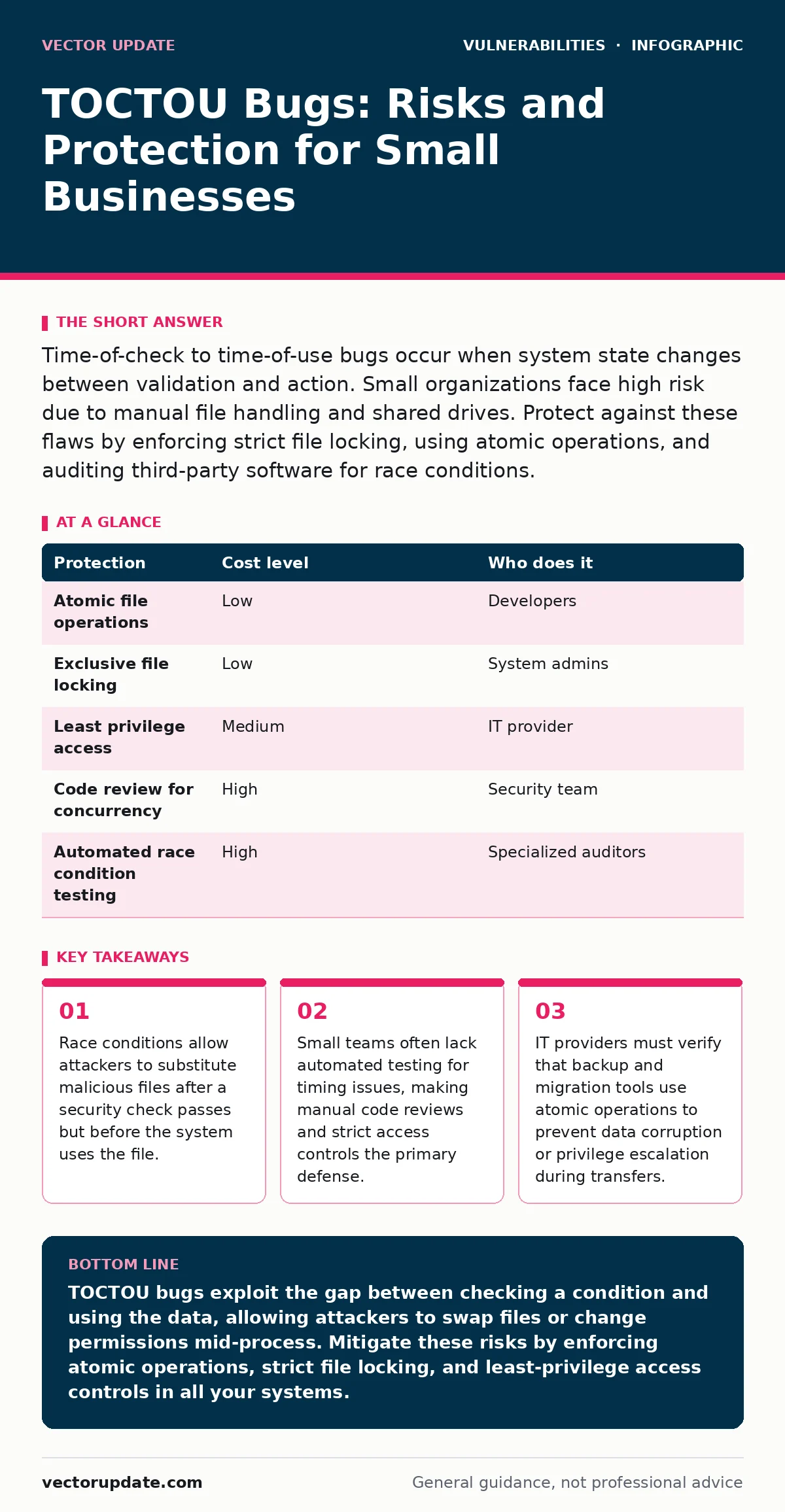
Time-of-check to time-of-use bugs occur when system state changes between validation and action. Small organizations face high risk due to manual file handling and shared drives. Protect against these flaws by enforcing strict file locking, using atomic operations, and auditing third-party software for race conditions.
How TOCTOU Bugs Bypass Security Checks
Time-of-check to time-of-use (TOCTOU) bugs exploit a window of vulnerability between two actions. A program checks a condition, such as file permissions or data integrity. Then it performs an action based on that check. If the underlying data changes between the check and the use, the program acts on incorrect assumptions. This race condition allows an attacker to substitute malicious content after the security gate has passed.
The core issue is that most operating systems are not atomic. An atomic operation completes in a single, uninterruptible step. If a system cannot perform a check and an action atomically, a gap exists. Attackers monitor these gaps. They trigger the check, then rapidly alter the environment before the action completes. This technique bypasses access controls that rely on sequential verification rather than simultaneous execution.
Small organizations are particularly exposed because they often rely on legacy scripts and manual processes. These systems frequently check permissions explicitly before opening a file. This design pattern is inherently flawed. It assumes the file system remains static during processing. In a busy network environment, files change constantly. Even routine updates or user edits can create the timing window an attacker needs.
Why Small Organizations Face Higher Risk
Small teams often lack dedicated security engineers to review code for concurrency issues. Developers may prioritize functionality over thread safety. They write scripts that read a configuration file, parse it, and then apply settings. If another process modifies the file during parsing, the script applies mixed or malicious data. This scenario is common in deployment scripts and backup utilities.
Shared resources amplify the danger. A shared drive or a cloud storage bucket allows multiple users to modify files simultaneously. If an application validates a file upload by checking its header, an attacker can upload a valid image, then quickly replace it with a script while the server processes the original header. The server trusts the initial check and executes the new content. This is a form of broken access control where the validation mechanism fails to account for dynamic state changes.
Another hidden cost is the complexity of debugging. TOCTOU bugs are non-deterministic. They may not appear during standard testing because the timing conditions are rare. A bug might manifest only under heavy load or specific network latency. This makes traditional quality assurance ineffective. Without specialized testing tools, these flaws remain hidden until an attacker exploits them in production.
Low-Cost Protections for File Systems
You can reduce TOCTOU risks by changing how your applications interact with the file system. The most effective method is to use atomic operations. Instead of checking a file and then opening it, open the file first. Then check the properties of the open handle. This ensures the file you are inspecting is the same file you are using. The operating system locks the file when it is open, preventing other processes from modifying it until you close the handle.
File locking is another critical control. When a process needs to read or write a file, it should acquire an exclusive lock. This prevents other processes from modifying the file simultaneously. Most modern operating systems support advisory and mandatory locking. Ensure your applications use these features correctly. A process that fails to lock a file before accessing it creates a potential race condition.
Limiting write permissions also helps. If a directory is read-only for the service account, attackers cannot swap files in that location. Use the principle of least privilege. Service accounts should only have write access to specific, isolated directories. This restricts the attacker's ability to place malicious files in paths that your applications trust. Combine this with exposure management practices to identify and secure all external-facing directories.
Protecting Against Code-Level Race Conditions
Developers must write code that assumes the environment is hostile and changing. Avoid separate checks for permissions and existence. Use functions that combine these actions. For example, instead of checking if a file exists and then opening it, use an open function that fails if the file does not exist or is inaccessible. This single system call eliminates the window between check and use.
Thread safety is vital in multi-threaded applications. If multiple threads access shared resources, use mutexes or semaphores to synchronize access. A mutex ensures that only one thread can modify a resource at a time. This prevents race conditions where one thread checks a value while another modifies it. Proper synchronization adds complexity but prevents subtle bugs that are hard to detect.
Be cautious with serialization mechanisms. Some formats, like Python pickle deserialization, are inherently unsafe if the input source is not trusted. An attacker can craft a payload that executes code during deserialization. If your application checks the source of the data but not its content, a TOCTOU-like attack can occur. Validate the integrity of serialized data using cryptographic signatures before processing it.
What to Ask Your IT Provider
Your IT provider plays a key role in identifying and mitigating these risks. They must understand the difference between static security checks and dynamic execution. Ask them how they handle file integrity during backups and migrations. Do their tools use atomic operations? Do they verify file hashes before and after transfer? A simple checksum check is not enough if the file can be swapped during the check.
Request a review of their scripting practices. Many providers use custom scripts for automation. These scripts are often the source of TOCTOU bugs. Ask if they use secure coding standards for their internal tools. Do they test for race conditions? Do they use established libraries rather than writing custom file-handling logic? Custom code is more likely to contain timing flaws than well-tested, open-source libraries.
Ensure they maintain an accurate IT asset inventory. You cannot protect what you do not know exists. Unmanaged scripts and legacy services are prime targets for TOCTOU attacks. Ask how they track and update all software components. Do they have a process for identifying and removing unused or insecure applications? Regular audits help reduce the attack surface.
| Protection | Cost level | Who does it |
|---|---|---|
| Atomic file operations | Low | Developers |
| Exclusive file locking | Low | System admins |
| Least privilege access | Medium | IT provider |
| Code review for concurrency | High | Security team |
| Automated race condition testing | High | Specialized auditors |
See also: Difference Between Identity and Access Management Explained · Principle of Least Privilege Example for System Security
Integrating Broader Security Practices
TOCTOU bugs do not exist in isolation. They often combine with other vulnerabilities to create severe exploits. For instance, an attacker might use a firmware update mechanism to inject malicious code if the update process has a race condition. The system checks the signature of the update file, then applies it. If the attacker can swap the file during this window, they can root the device.
Similarly, browser extension vulnerabilities can exploit race conditions in the browser's security model. An extension might check a URL's safety, then load the content. If the URL redirects during this check, the extension loads malicious content. Understanding these cross-cutting risks helps you prioritize fixes. Focus on areas where timing attacks can bypass multiple layers of defense.
Consider bug bounty triage if you have public-facing applications. External researchers often find race conditions that internal teams miss. They have the incentive and the tools to probe for timing issues. A well-run bug bounty program can uncover TOCTOU bugs before attackers do. Ensure your triage process includes specialists who understand concurrency and race conditions.
Final Checklist for Small Teams
Small teams must prioritize simplicity and strict controls. Complex systems are harder to secure against timing attacks. Use established frameworks and libraries that handle concurrency correctly. Avoid writing custom code for file handling or permission checks unless necessary.
Regularly audit your access controls. Ensure that service accounts have the minimum permissions required. Review logs for unusual file activity, such as rapid renaming or swapping. While logs do not prevent TOCTOU bugs, they can help you detect an exploit after it occurs.
Key takeaways
- Race conditions allow attackers to substitute malicious files after a security check passes but before the system uses the file.
- Small teams often lack automated testing for timing issues, making manual code reviews and strict access controls the primary defense.
- IT providers must verify that backup and migration tools use atomic operations to prevent data corruption or privilege escalation during transfers.
TOCTOU bugs exploit the gap between checking a condition and using the data, allowing attackers to swap files or change permissions mid-process. Mitigate these risks by enforcing atomic operations, strict file locking, and least-privilege access controls in all your systems.
Frequently asked questions
Can antivirus software prevent TOCTOU attacks?
Antivirus software typically scans files at rest or in transit. It cannot easily detect changes that occur in the milliseconds between a security check and file execution. Behavioral monitoring may help, but it is not a definitive prevention method.
How do I know if my software has a TOCTOU bug?
Look for code patterns that separate permission checks from file operations. If a script checks a file's properties and then opens it in a separate step, it is vulnerable. Code reviews and static analysis tools can identify these patterns.
Are cloud storage services safe from TOCTOU bugs?
Cloud providers implement atomic operations for many services, but client-side applications can still be vulnerable. If your application downloads a file, checks it, and then processes it, a race condition can occur on the client side. Secure the client code, not just the cloud storage.
What is the difference between TOCTOU and a standard race condition?
TOCTOU is a specific type of race condition involving security checks. A general race condition might cause data corruption or crashes. TOCTOU specifically allows an attacker to bypass security controls by changing the state between a check and an action.
How this guide was produced: written by the Vector Update editorial team with AI assistance, checked against the public references listed below, and reviewed when the facts change. See our editorial policy or report an error.