WebSocket Vulnerabilities: How Attacks Work and How to Stop Them
WebSocket flaws often bypass traditional web defenses by maintaining persistent connections that hide malicious payloads from standard request inspection tools.

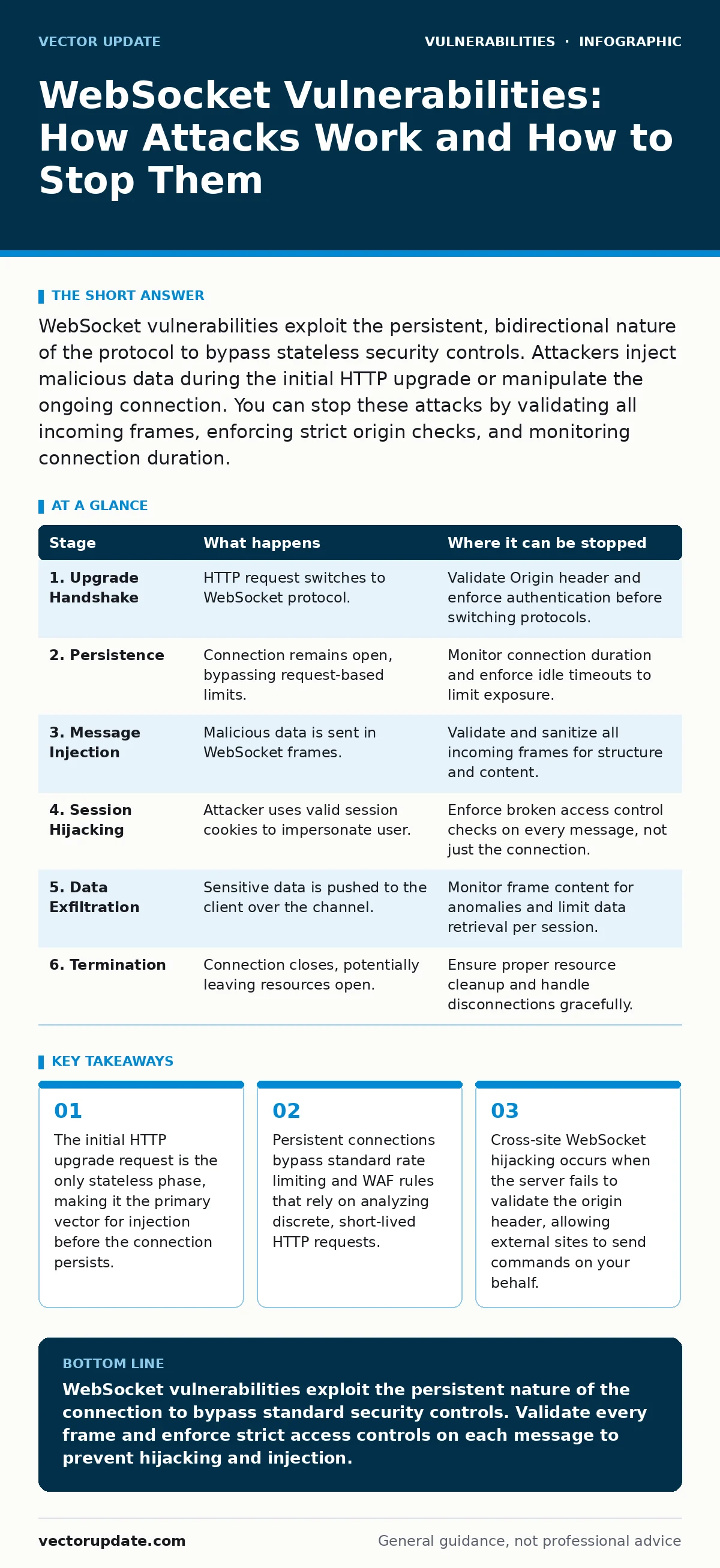
WebSocket vulnerabilities exploit the persistent, bidirectional nature of the protocol to bypass stateless security controls. Attackers inject malicious data during the initial HTTP upgrade or manipulate the ongoing connection. You can stop these attacks by validating all incoming frames, enforcing strict origin checks, and monitoring connection duration.
The Protocol Shift and Initial Exposure
WebSockets transform a standard HTTP connection into a persistent, full-duplex channel. This shift creates a unique security boundary. The connection begins with an HTTP request that includes an Upgrade header. The server responds with a status code of 101 Switching Protocols. This moment is critical. It is the last time the connection behaves like a standard web request. Traditional security tools inspect HTTP requests. They often ignore the subsequent WebSocket frames because they are not HTTP. This blind spot allows attackers to hide malicious activity inside the persistent stream.
Stage 1: The Upgrade Handshake
Stage 1: The Upgrade Handshake
The attacker targets the initial handshake. This phase relies on standard HTTP mechanisms. The client sends a request to a specific endpoint. The server validates the request. If valid, the server switches protocols. The flaw usually lies in insufficient validation during this switch. Attackers may manipulate the Origin header or inject parameters into the query string. The server must verify that the request comes from an authorized domain. If the server accepts the upgrade without strict origin validation, it opens the door to cross-site attacks. This stage is stateless. It behaves like any other web request. Security controls that inspect HTTP headers can still operate here.
Stage 2: Connection Persistence and Bypass
Stage 2: Connection Persistence and Bypass
Once the protocol switches, the connection persists. This persistence breaks the assumptions of many security defenses. Firewalls and Web Application Firewalls often rate-limit based on request volume per second. A single WebSocket connection counts as one request. It can remain open for hours. It can send thousands of messages. The firewall sees only one connection. It does not see the volume of data flowing through it. This allows attackers to bypass rate limiting. They can flood the application with data. They can perform slowloris-style attacks by keeping connections open. The defense must shift from counting requests to monitoring connection duration and data volume per connection.
Stage 3: Message Injection and Manipulation
Stage 3: Message Injection and Manipulation
The attacker now sends data through the open channel. The data arrives in frames. These frames can be text or binary. The server must parse and validate every frame. If the server trusts the connection, it may trust the data. This trust is the vulnerability. Attackers inject malformed frames. They may send oversized payloads to cause buffer overflows. They may send specially crafted JSON to trigger parsing errors. They may inject script code if the server reflects the data back to the client without sanitization. This leads to cross-site scripting (XSS) vulnerabilities. The server must treat every frame as untrusted input. It must validate the structure and content before processing.
Stage 4: Session Hijacking and Access Control
Stage 4: Session Hijacking and Access Control
WebSockets often carry session cookies. The browser attaches these cookies to the upgrade request. If the server does not enforce strict access controls, the connection inherits the user’s privileges. Attackers can hijack these sessions. They use cross-site scripting to steal the WebSocket connection. They use cross-site WebSocket hijacking to impersonate the user.
The server must verify that the connection owner is authorized to perform each action. Broken access control is a common result. The server assumes that because the connection is open, the user is authorized. It must check permissions for every message, not just the initial connection. This prevents an attacker from performing administrative actions using a compromised user connection.
See also: Difference Between Identity and Access Management Explained · Principle of Least Privilege Example for System Security
Stage 5: Data Exfiltration and Persistence
Stage 5: Data Exfiltration and Persistence
The attacker uses the persistent channel to steal data. The channel is bidirectional. The server can push data to the client. The attacker can force the server to send sensitive information. They may trigger error messages that reveal internal paths. They may query the server for database records. The data flows out in small chunks. It blends with normal application traffic. Detection is difficult. Standard monitoring looks for large outbound transfers. WebSocket traffic looks like normal application updates. You must monitor the content of the frames. You must detect anomalies in the data being sent. You must limit the amount of data that can be retrieved in a single session.
Stage 6: Connection Termination and Cleanup
Stage 6: Connection Termination and Cleanup
The attacker closes the connection. The server must clean up resources. It must close the socket. It must release memory. It must log the session. If the server fails to clean up properly, it may leave resources open. This can lead to memory leaks. It can lead to denial of service. The attacker may open thousands of connections. They close them slowly. The server runs out of file descriptors. The application crashes. Proper cleanup is vital. The server must handle disconnections gracefully. It must validate the close frame. It must ensure that all resources are released. This prevents resource exhaustion attacks.
Summary of Attack Stages
| Stage | What happens | Where it can be stopped |
|---|---|---|
| 1. Upgrade Handshake | HTTP request switches to WebSocket protocol. | Validate Origin header and enforce authentication before switching protocols. |
| 2. Persistence | Connection remains open, bypassing request-based limits. | Monitor connection duration and enforce idle timeouts to limit exposure. |
| 3. Message Injection | Malicious data is sent in WebSocket frames. | Validate and sanitize all incoming frames for structure and content. |
| 4. Session Hijacking | Attacker uses valid session cookies to impersonate user. | Enforce broken access control checks on every message, not just the connection. |
| 5. Data Exfiltration | Sensitive data is pushed to the client over the channel. | Monitor frame content for anomalies and limit data retrieval per session. |
| 6. Termination | Connection closes, potentially leaving resources open. | Ensure proper resource cleanup and handle disconnections gracefully. |
Mitigation and Defense Strategies
You must defend the WebSocket lifecycle. Start with the handshake. Validate the origin. Authenticate the user. Move to the connection. Limit the duration. Monitor the volume. Handle the messages. Validate every frame. Sanitize the input. Check the permissions. Clean up the resources. Close the socket. Log the activity. This layered approach addresses the unique risks of the protocol. It compensates for the blind spots in traditional security tools. It ensures that the persistent nature of the connection does not become a liability.
Conclusion of the Attack Path
The attack path is clear. It exploits the transition from stateless to stateful. It hides in the persistent channel. It abuses the trust of the session. You can interrupt it at every stage. You must validate at the start. You must monitor in the middle. You must clean up at the end. This requires a shift in mindset. You must treat the WebSocket connection as a continuous attack surface. You must apply the same rigor to every frame as you do to every HTTP request. This ensures that the convenience of real-time communication does not compromise security.
Key takeaways
- The initial HTTP upgrade request is the only stateless phase, making it the primary vector for injection before the connection persists.
- Persistent connections bypass standard rate limiting and WAF rules that rely on analyzing discrete, short-lived HTTP requests.
- Cross-site WebSocket hijacking occurs when the server fails to validate the origin header, allowing external sites to send commands on your behalf.
WebSocket vulnerabilities exploit the persistent nature of the connection to bypass standard security controls. Validate every frame and enforce strict access controls on each message to prevent hijacking and injection.
Frequently asked questions
Do WebSockets bypass firewalls?
WebSockets often bypass application-layer firewalls because the persistent connection looks like a single HTTP request to traditional inspection tools.
How does cross-site WebSocket hijacking work?
It works when the server fails to validate the Origin header, allowing an external site to open a WebSocket connection using the victim’s session cookies.
Can WebSockets cause cross-site scripting?
Yes, if the server reflects unsanitized input from a WebSocket frame back to the client, it can execute malicious scripts in the user’s browser.
Are WebSockets secure by default?
No, WebSockets are not secure by default. They require explicit validation of origins, authentication of connections, and sanitization of all data frames.
How this guide was produced: written by the Vector Update editorial team with AI assistance, checked against the public references listed below, and reviewed when the facts change. See our editorial policy or report an error.