What Is Supply Chain Attacks: How Indirect Compromise Works
Attackers bypass your direct defenses by corrupting the trusted software or hardware you install, turning your trust into a vector for intrusion.

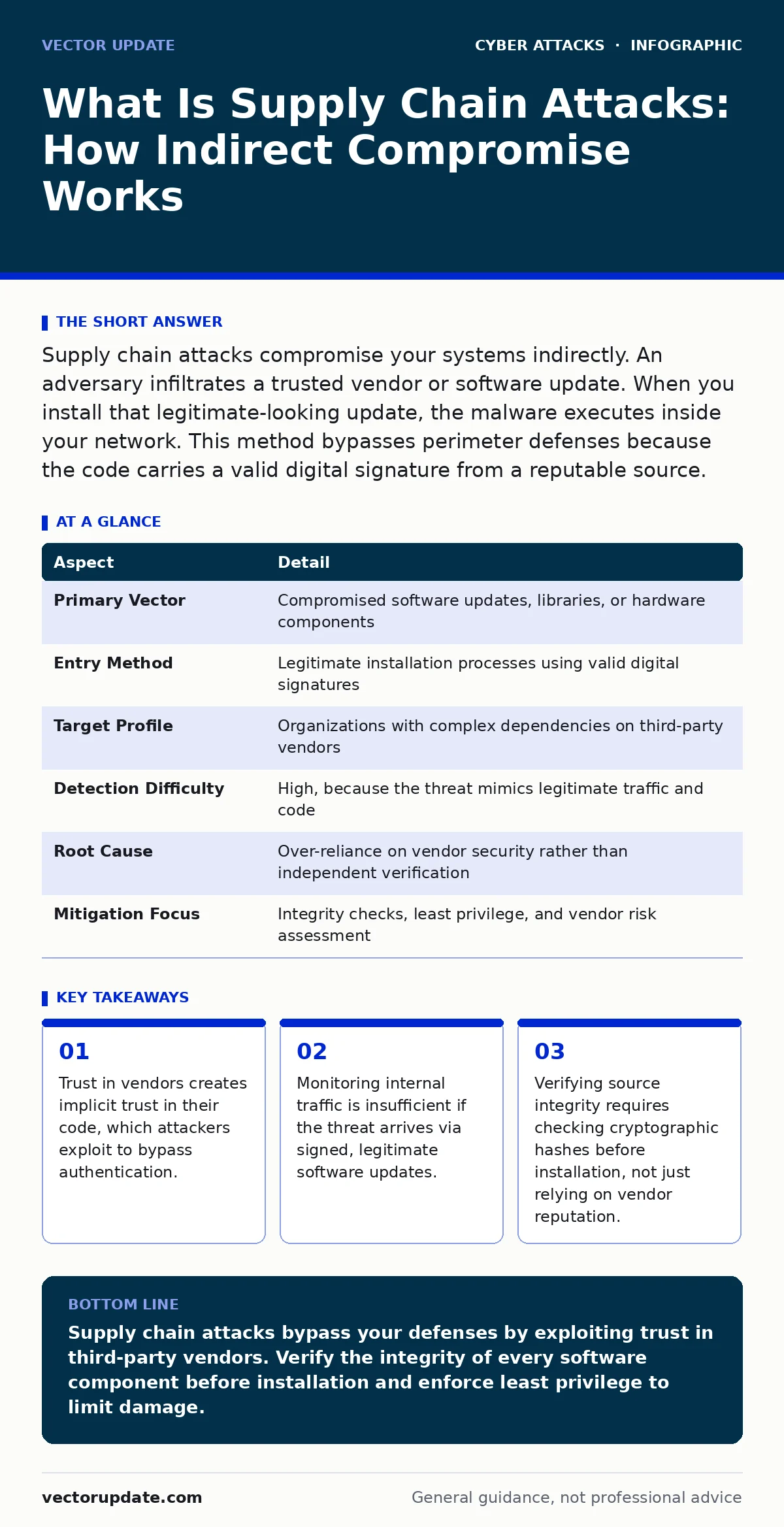
Supply chain attacks compromise your systems indirectly. An adversary infiltrates a trusted vendor or software update. When you install that legitimate-looking update, the malware executes inside your network. This method bypasses perimeter defenses because the code carries a valid digital signature from a reputable source.
An Everyday Analogy for Indirect Compromise
Imagine you hire a reputable contractor to repair your roof. You trust this contractor because they have worked for years without incident. You do not inspect every nail or shingle they bring to your site. Suppose a thief bribes the contractor’s supplier to include a hidden camera inside one of the shingles. When the contractor installs the shingles, the camera enters your home. The thief did not break your lock. The thief used your trust in the contractor to gain access.
Supply chain attacks operate on this same principle of trusted intermediaries. You trust a software vendor to provide safe code. The vendor’s build process is compromised. The malicious code rides inside the legitimate update. Your security tools allow the update because it looks correct. The attacker is now inside your environment, hidden behind a layer of legitimate trust.
What Is Supply Chain Attacks
Supply chain attacks are a specific class of cyber intrusion that targets the dependencies of a target organization. Rather than attacking your firewall or phishing your employees directly, the attacker compromises a third-party provider. This provider could be a software developer, a hardware manufacturer, or a cloud service provider. The attacker inserts malicious code or hardware into the products this provider sells.
When you install the compromised product, you introduce the threat directly into your secure environment. The attack succeeds because your security controls are designed to stop external threats. They are often less rigorous about verifying internal or trusted external inputs. The malicious payload executes with the permissions you granted to the vendor. This makes detection difficult and remediation costly.
| Aspect | Detail |
|---|---|
| Primary Vector | Compromised software updates, libraries, or hardware components |
| Entry Method | Legitimate installation processes using valid digital signatures |
| Target Profile | Organizations with complex dependencies on third-party vendors |
| Detection Difficulty | High, because the threat mimics legitimate traffic and code |
| Root Cause | Over-reliance on vendor security rather than independent verification |
| Mitigation Focus | Integrity checks, least privilege, and vendor risk assessment |
How the Attack Mechanism Works
The attacker begins by identifying a vendor that serves many potential targets. This vendor does not need to be large, only widely used. The attacker then compromises the vendor’s development environment. This might involve stealing credentials used for building software or inserting malware into the source code repository. Once the build process is controlled, the attacker creates a version of the software that contains hidden malicious code.
This malicious version is signed with the vendor’s legitimate digital certificate. Digital signatures prove that the code comes from the vendor and has not been altered. Your systems verify this signature and allow the installation. The malware executes in the background. It may establish a command-and-control channel, steal data, or prepare for further lateral movement. Because the code is signed, antivirus software often ignores it. The attack relies on the verification of identity, not the verification of intent.
Who Is Affected by These Threats
Any organization that relies on third-party software or hardware is a potential target. This includes nearly every modern business. The risk scales with the number of dependencies you have. Companies that use complex software stacks are more vulnerable because they have more entry points. Small businesses are not immune. They often use the same commercial software as large enterprises. If that software is compromised, the small business suffers the same exposure.
Critical infrastructure providers face heightened risk. Power grids, water treatment facilities, and healthcare systems rely on specialized hardware and software. These systems often run for years without updates. When an update is finally issued, it may carry a payload that has been waiting in the supply chain for months. The impact on these sectors is severe because the disruption affects public safety and daily life. The attacker does not need to target the hospital directly. They only need to target the vendor that provides the hospital’s imaging software.
What People Usually Get Wrong
Many organizations believe that scanning incoming files for malware is sufficient. This assumption fails against supply chain attacks. The malicious code is often obfuscated or encrypted until it reaches the target environment. Standard signature-based detection cannot identify new, custom malware. The code looks like legitimate functionality until it triggers its payload. Relying solely on antivirus software leaves a significant blind spot.
Another common error is assuming that open-source software is less risky than commercial software. Open-source projects often have fewer resources for security auditing. They rely on volunteer maintainers who may not follow strict security protocols. An attacker can target a single, less popular library that is widely used as a dependency. This is known as a dependency confusion attack. The attacker registers a package with a similar name to a legitimate one. If your build system checks internal repositories before public ones, it may pull the malicious package.
See also: Cryptomining Attacks on Exposed Servers: Detection and Mitigation
Technical Mitigation Strategies
You must shift from trusting vendors to verifying integrity. Implement strict verification of software artifacts before installation. Use cryptographic hashes to ensure that the file you receive matches the file the vendor published. If the hash does not match, the file has been altered. Do not install it. This check must happen in your build pipeline, not just on user workstations.
Adopt the principle of least privilege. Software updates should not run with administrative privileges unless absolutely necessary. If the compromised code executes with limited permissions, its ability to cause damage is reduced. You can contain the breach more easily. Use privileged access management to control who can approve and deploy updates. This adds a human check to the automated process.
Monitor for unusual behavior after updates. Look for new outbound connections, unexpected process creation, or changes to system files. Intrusion prevention systems can help detect known malicious patterns, but they may miss novel attacks. Combine network monitoring with endpoint detection. This layered approach increases the chance of catching an anomaly. If you suspect a compromise, isolate the affected systems immediately. Do not wait for confirmation.
Managing Vendor Risk Continuously
Security is not a one-time configuration. You must continuously assess the risk posed by your vendors. Review their security practices regularly. Ask for evidence of their security controls. Do not accept generic statements. Look for specific details about their development lifecycle, code signing processes, and incident response plans. If a vendor cannot provide this information, consider them a high-risk dependency.
Diversify your suppliers where possible. Relying on a single vendor for critical services creates a single point of failure. If that vendor is compromised, your entire operation is at risk. Having alternative vendors allows you to switch providers quickly if a breach occurs. This reduces your exposure and increases your resilience.
Educate your development and operations teams. They are the ones who select libraries and approve updates. They need to understand the risks of supply chain attacks. They should know how to verify packages and recognize suspicious behavior. Regular training reinforces these practices. It ensures that security is integrated into the development process, not added as an afterthought.
Key takeaways
- Trust in vendors creates implicit trust in their code, which attackers exploit to bypass authentication.
- Monitoring internal traffic is insufficient if the threat arrives via signed, legitimate software updates.
- Verifying source integrity requires checking cryptographic hashes before installation, not just relying on vendor reputation.
Supply chain attacks bypass your defenses by exploiting trust in third-party vendors. Verify the integrity of every software component before installation and enforce least privilege to limit damage.
Frequently asked questions
How do I know if my software has been compromised?
Check the cryptographic hash of the downloaded file against the hash published by the vendor. Monitor for unexpected network connections or process behavior after installation. Look for alerts from your intrusion detection systems.
Can open-source software be used in a supply chain attack?
Yes, open-source libraries are frequent targets. Attackers compromise popular repositories or impersonate maintainers. Always verify the source and hash of open-source packages before using them in production environments.
Does using a VPN protect against supply chain attacks?
No, a VPN encrypts traffic but does not verify the integrity of the software you install. A malicious update will still be delivered and installed if your systems trust the vendor’s digital signature. You need integrity checks, not just encryption.
What is the difference between a supply chain attack and a direct hack?
A direct hack targets your systems directly, often through vulnerabilities or phishing. A supply chain attack targets a vendor or dependency you trust. The attacker uses that trust to gain access to your network indirectly, bypassing your perimeter defenses.
How this guide was produced: written by the Vector Update editorial team with AI assistance, checked against the public references listed below, and reviewed when the facts change. See our editorial policy or report an error.