Difference between OSI model and TCP IP protocol suite clarified
The Open Systems Interconnection reference structure organizes theory, while Transmission Control Protocol and Internet Protocol software builds practical networks.

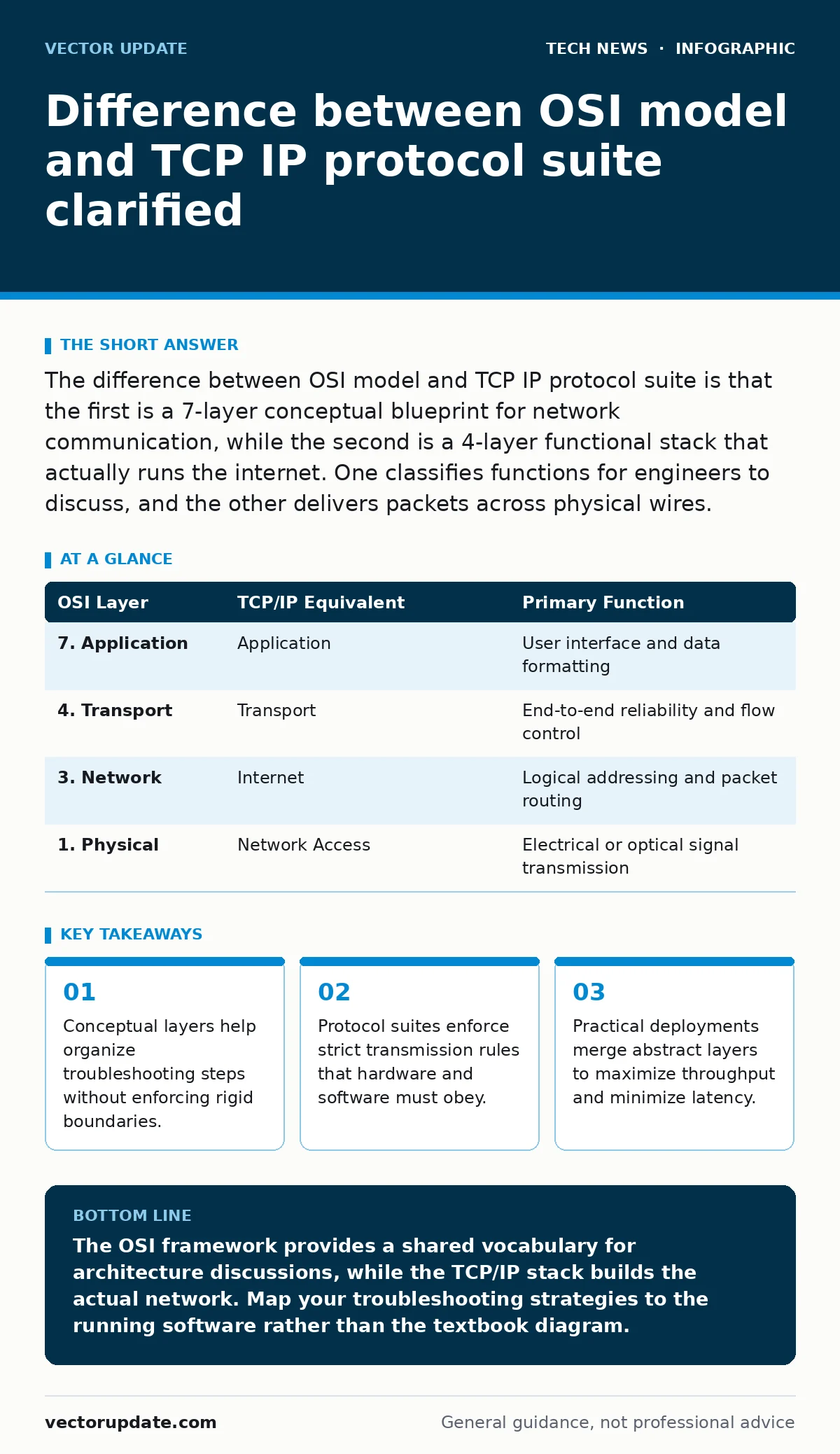
The difference between OSI model and TCP IP protocol suite is that the first is a 7-layer conceptual blueprint for network communication, while the second is a 4-layer functional stack that actually runs the internet. One classifies functions for engineers to discuss, and the other delivers packets across physical wires.
Are the layers of both architectures directly comparable?
The layers of both architectures are not directly comparable because they were designed with different goals. The Open Systems Interconnection model separates presentation and session functions into distinct tiers, whereas the Transmission Control Protocol and Internet Protocol suite merges those responsibilities into a single application layer. Mapping theoretical boundaries onto running code often creates confusion during troubleshooting sessions.
Imagine a network packet moving through a routing device that enforces strict policy rules. This divergence means an engineer cannot assume a strict one-to-one relationship between abstract definitions and physical packet headers.
| OSI Layer | TCP/IP Equivalent | Primary Function |
|---|---|---|
| 7. Application | Application | User interface and data formatting |
| 4. Transport | Transport | End-to-end reliability and flow control |
| 3. Network | Internet | Logical addressing and packet routing |
| 1. Physical | Network Access | Electrical or optical signal transmission |
Why does the theoretical model contain seven tiers?
The theoretical model contains 7 tiers to isolate specific networking functions into manageable academic categories. Each tier communicates exclusively with the tier immediately above and below it through defined interfaces. This modular design allowed researchers to develop protocols for hardware routing without worrying about how application software formatted text.
Network monitoring tools often display data that blurs these clean lines, grouping multiple functions together for practical analysis. Hardware manufacturers frequently implement features that span across adjacent tiers to speed up packet processing. Treating the 7-tier structure as an absolute law of physics rather than a teaching aid leads to flawed architectural assumptions.
How does the practical suite handle data encapsulation?
The practical suite handles data encapsulation by adding headers as information descends through functional layers. Application data receives a transport header, which receives an internet header, followed finally by a network access frame wrapper. Every receiving device strips these wrappers in reverse order to extract the original payload.
What hidden costs emerge from strict layered designs?
Strict layered designs impose hidden performance costs through redundant header processing and memory copying. Each boundary crossing requires the operating system to move packet buffers between different memory spaces, adding latency to high-speed data streams. Developers aiming for maximum throughput often bypass standard OS networking stacks entirely to reduce these overhead penalties.
Developers working on high-performance environments frequently integrate DevOps security checks directly into the transport processing path to minimize these latency penalties. Simplifying stack traversal prevents bottlenecks that otherwise throttle modern fiber optic links. Recognizing these processing overheads helps administrators tune interface cards for maximum efficiency.
Where does the usual textbook definition fail?
The usual textbook definition fails when modern encapsulation protocols tunnel one packet type inside another. A virtual private network tunnel wraps an entire IP packet inside a new transport header, effectively inverting the standard hierarchical flow. This wrapping makes higher-layer protocols appear at lower logical positions during packet captures.
Suppose an external service provider reroutes traffic through an encrypted overlay network that masks the inner payload. Traditional inspection engines fail to categorize the traffic correctly because the outer header conceals the actual application data. IT asset management databases must account for these virtual interfaces rather than relying solely on physical port inventories.
When should an engineer ignore the conceptual boundaries?
An engineer should ignore the conceptual boundaries when tuning kernel parameters for high-throughput database servers. Modern operating systems merge transport and network processing tasks into unified execution threads to avoid unnecessary context switches. Respecting textbook purity in such environments degrades transaction speeds and increases memory consumption.
Integrating IoT security policies into edge routers often requires inspecting application payloads directly at the network access layer. Hardware acceleration chips blur these functional lines deliberately to achieve line-rate speeds. Understanding the actual implementation details matters far more than matching traffic patterns to academic diagrams.
Key takeaways
- Conceptual layers help organize troubleshooting steps without enforcing rigid boundaries.
- Protocol suites enforce strict transmission rules that hardware and software must obey.
- Practical deployments merge abstract layers to maximize throughput and minimize latency.
The OSI framework provides a shared vocabulary for architecture discussions, while the TCP/IP stack builds the actual network. Map your troubleshooting strategies to the running software rather than the textbook diagram.
Frequently asked questions
Do routers care about the upper layers of the OSI model?
Traditional routers operate primarily at the network layer and ignore upper-tier payload details. Modern smart routers may inspect application headers to prioritize specific traffic types.
Why do network engineers still use the seven-layer model?
Engineers use the model because it provides a common language for isolating faults across different hardware and software vendors.
Can a protocol exist outside these models?
Proprietary or experimental protocols often blur layer boundaries or omit certain functions entirely. They still must translate into electrical or optical signals to cross physical media.
Is the TCP/IP suite owned by any single organization?
The protocol suite is maintained through open standards bodies and cooperative engineering groups rather than a single corporate entity.
How this guide was produced: written by the Vector Update editorial team with AI assistance, checked against the public references listed below, and reviewed when the facts change. See our editorial policy or report an error.