The difference between asset management and cmdb and how to choose
Asset management tracks financial lifecycles while configuration databases map operational dependencies, and using one for the other creates blind spots.
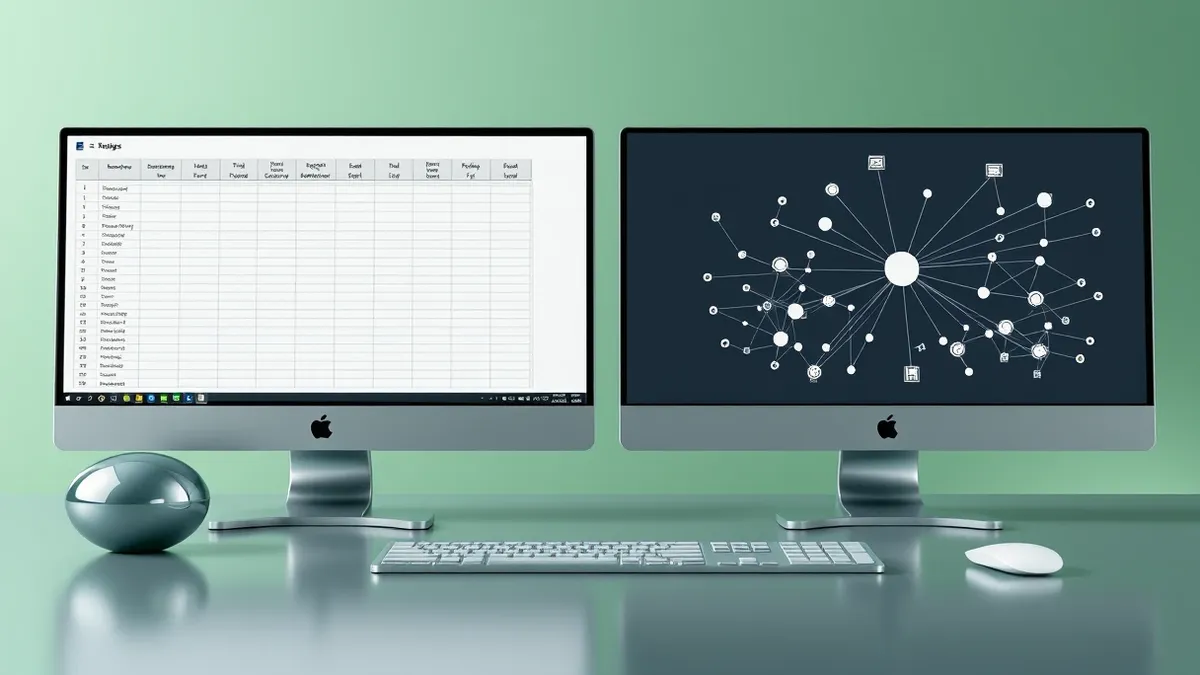
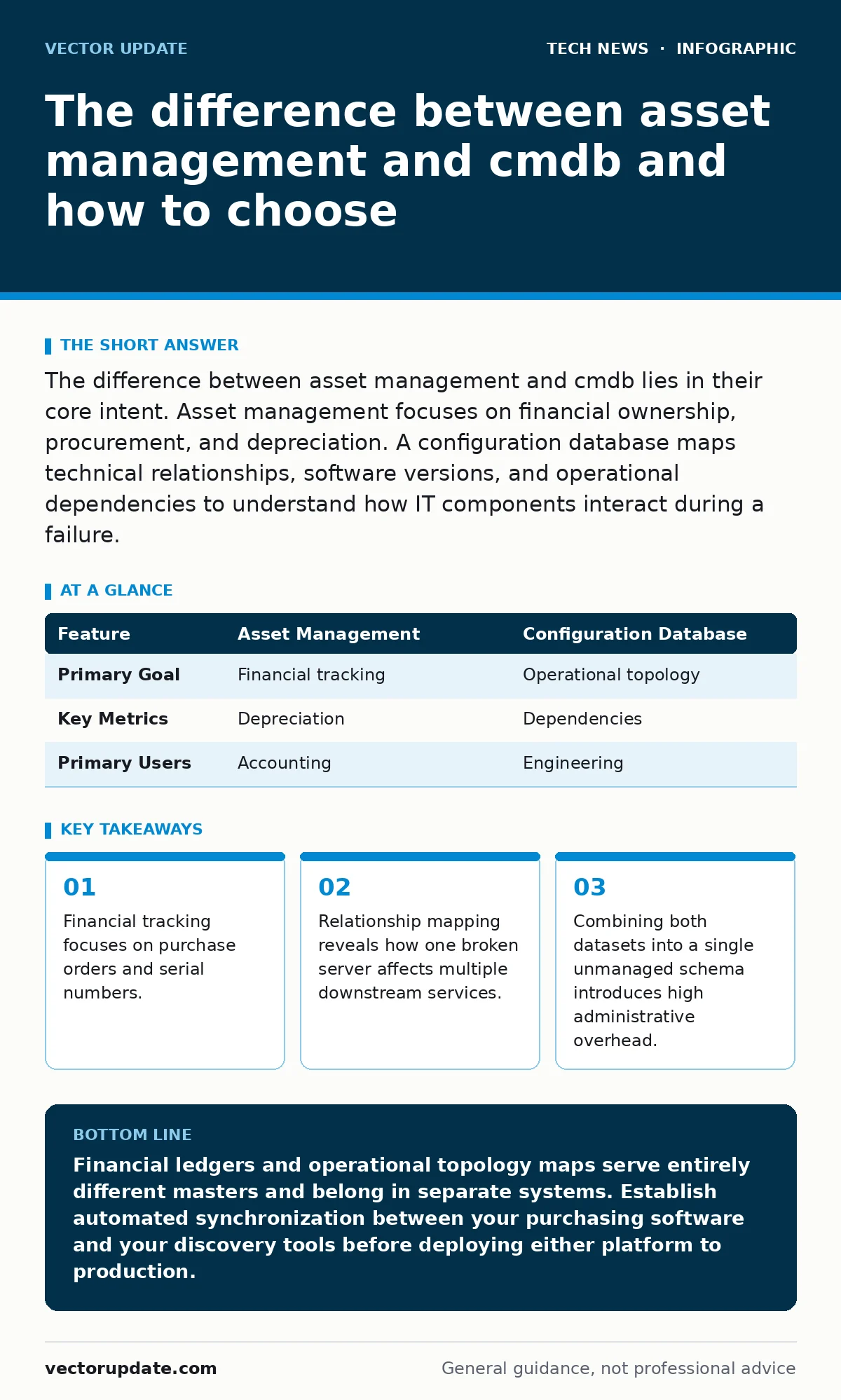
The difference between asset management and cmdb lies in their core intent. Asset management focuses on financial ownership, procurement, and depreciation. A configuration database maps technical relationships, software versions, and operational dependencies to understand how IT components interact during a failure.
What is the difference between asset management and cmdb?
The difference between asset management and cmdb involves a fundamental shift in perspective from accounting to operations. Asset management records what you own, who bought it, and when it retires from service. A configuration management database, known as a CMDB, records how items connect, what software runs on them, and which business services rely on their uptime.
Asset management treats every physical laptop, server chassis, and software license as a discrete financial unit. The primary goal is maintaining accurate books for tax purposes, software compliance audits, and replacement budgeting. You answer questions about total cost of ownership and physical location rather than network topology or software dependencies.
A configuration management database treats infrastructure as a web of interconnected dependencies rather than a list of standalone items. The primary goal is understanding how a single broken router impacts customer-facing web applications. You answer questions about blast radius and service continuity rather than purchase orders or vendor warranties.
Why do financial audits require a dedicated asset database?
Financial audits require a dedicated asset database because accountants care about depreciation, vendor contracts, and physical locations. Asset management systems link hardware serial numbers directly to purchase orders and cost centers. Operational databases discard this financial metadata because ledger entries add noise when engineers troubleshoot a downed database cluster.
Auditors demand proof that physical assets match the balance sheet down to the exact serial number and room number. Financial tracking tools excel at recording vendor warranty expirations, lease agreements, and disposal certificates for retired hardware. Operational tools lack the required fields for tracking residual book value or tax depreciation methods.
Imagine an organization trying to pass a rigorous financial audit using only an operational topology map. The operational database might show that a server exists and runs a payroll application, but it completely misses the lease contract, purchase cost, and asset tag required by the accounting department.
How do technical relationships change the way you track items?
Technical relationships change the way you track items by shifting focus from individual units to complex topologies. A configuration item, representing any deployable component in your infrastructure, links to upstream applications and downstream switches. You cannot manage these dynamic linkages using static spreadsheets designed solely for accounting departments.
Engineers visualize infrastructure through layers that resemble the OSI model, where physical cables support network protocols, which in turn support operating systems and databases. Mapping these dependencies requires a database structure built for parent-child relationships rather than flat rows and columns. A change in one component instantly ripples across every connected service.
Suppose a core database server requires a sudden memory upgrade during off-peak hours. An operational tracking tool reveals all downstream applications that will lose connection during the reboot. An asset management tool merely notes that a memory module was added, missing the critical context of which business functions depend on that specific server.
What happens when you mix procurement data with operational data?
Mixing procurement data with operational data creates a bloated system that satisfies neither finance nor engineering teams. Procurement officers need rigid records that rarely change after purchase. Engineers need fluid records that update constantly as developers spin up virtual machines and alter network configurations.
| Feature | Asset Management | Configuration Database |
|---|---|---|
| Primary Goal | Financial tracking | Operational topology |
| Key Metrics | Depreciation | Dependencies |
| Primary Users | Accounting | Engineering |
When organizations force both data types into a single platform, permission models become an administrative nightmare. Finance workers should not have write access to operational topology maps, and engineers should not edit depreciation tables. Combining these domains leads to stale data because neither group takes full ownership of the hybrid database schema.
When should you maintain separate tools for tracking hardware?
Maintaining separate tools for tracking hardware prevents administrative gridlock during major enterprise changes. Separate systems let procurement staff update depreciation schedules without accidentally breaking the automated service maps that engineers rely on during an outage. This separation of concerns mirrors how network address translation isolates private subnets from public routing tables.
Integration between the two systems should happen via automated application programming interfaces rather than manual duplicate entry. When procurement registers a new server, the purchasing system can push the serial number and model into the operational database. From that point onward, the operational tool tracks uptime while the financial tool tracks depreciation.
Suppose your finance team retires an aging storage array due to high maintenance costs. The asset system triggers an automated workflow that alerts the engineering team to migrate stored data before the hardware is physically unplugged. This workflow prevents accidental outages caused by poor communication between departments.
See also: macOS security settings control access to system resources
How does network monitoring feed data into your tracking systems?
Network monitoring feeds data into your tracking systems by discovering active devices and recording their current operational states. Automated discovery tools sweep your subnets to find unauthorized hardware plugged into wall ports. These discovery engines populate your configuration database with real-time facts while leaving fixed purchase dates inside your financial ledger.
Discovery tools detect changes instantly when a virtual machine migrates to a different physical host or a firewall rule changes. Asset management tools cannot rely on automated network scans for financial compliance because an active scan does not verify ownership, lease terms, or invoice numbers. Combining automated network discovery with manual procurement entry ensures complete coverage.
Imagine a rogue developer spinning up unauthorized cloud servers that bypass corporate procurement channels entirely. An operational discovery tool detects the new instances immediately because they appear on the corporate network. The financial asset database remains completely blind to these rogue instances until purchasing records catch up with reality.
What are the hidden maintenance costs of keeping records accurate?
Hidden maintenance costs of keeping records accurate destroy poorly planned tracking projects within 1 year. Every automated discovery rule requires ongoing tuning to prevent duplicate entries caused by rebooted hypervisors or changing network addresses. Manual updates fail because technicians rarely remember to log inventory changes while rushing to fix a critical outage.
Data drift occurs silently when configuration items are decommissioned without updating the central database records. Stale operational maps cause prolonged troubleshooting sessions because engineers rely on ghost dependencies that no longer exist in the physical datacenter. Assigning explicit ownership for every tracked record prevents your database from turning into a digital wasteland.
Organizations often underestimate the ongoing labor required to maintain clean configuration data over multiple years. Hiring dedicated inventory custodians or automating record validation checks helps preserve data integrity. Without continuous governance, your expensive tracking tools will contain less accurate information than a simple text file.
Key takeaways
- Financial tracking focuses on purchase orders and serial numbers.
- Relationship mapping reveals how one broken server affects multiple downstream services.
- Combining both datasets into a single unmanaged schema introduces high administrative overhead.
Financial ledgers and operational topology maps serve entirely different masters and belong in separate systems. Establish automated synchronization between your purchasing software and your discovery tools before deploying either platform to production.
Frequently asked questions
Can a single software platform handle both asset management and configuration tracking?
Many enterprise software suites offer modules for both functions, but they typically maintain separate underlying database tables and access controls to prevent data corruption.
Who should own the configuration database within an organization?
Operations and site reliability engineering teams should own the configuration database because they rely on its dependency maps during incident response.
How often should automated discovery tools scan the network?
Continuous background discovery works best for dynamic environments, while scheduled daily scans suit stable networks to avoid excessive resource consumption.
Do software licenses belong in an asset management tool or a configuration database?
Software licenses belong primarily in asset management for cost compliance, though the configuration database should record which servers actually run those licensed applications.
How this guide was produced: written by the Vector Update editorial team with AI assistance, checked against the public references listed below, and reviewed when the facts change. See our editorial policy or report an error.