Difference between transparency and explainability in ai systems and why it matters
Transparency covers the entire lifecycle of a model, while explainability focuses solely on why a specific output occurred.

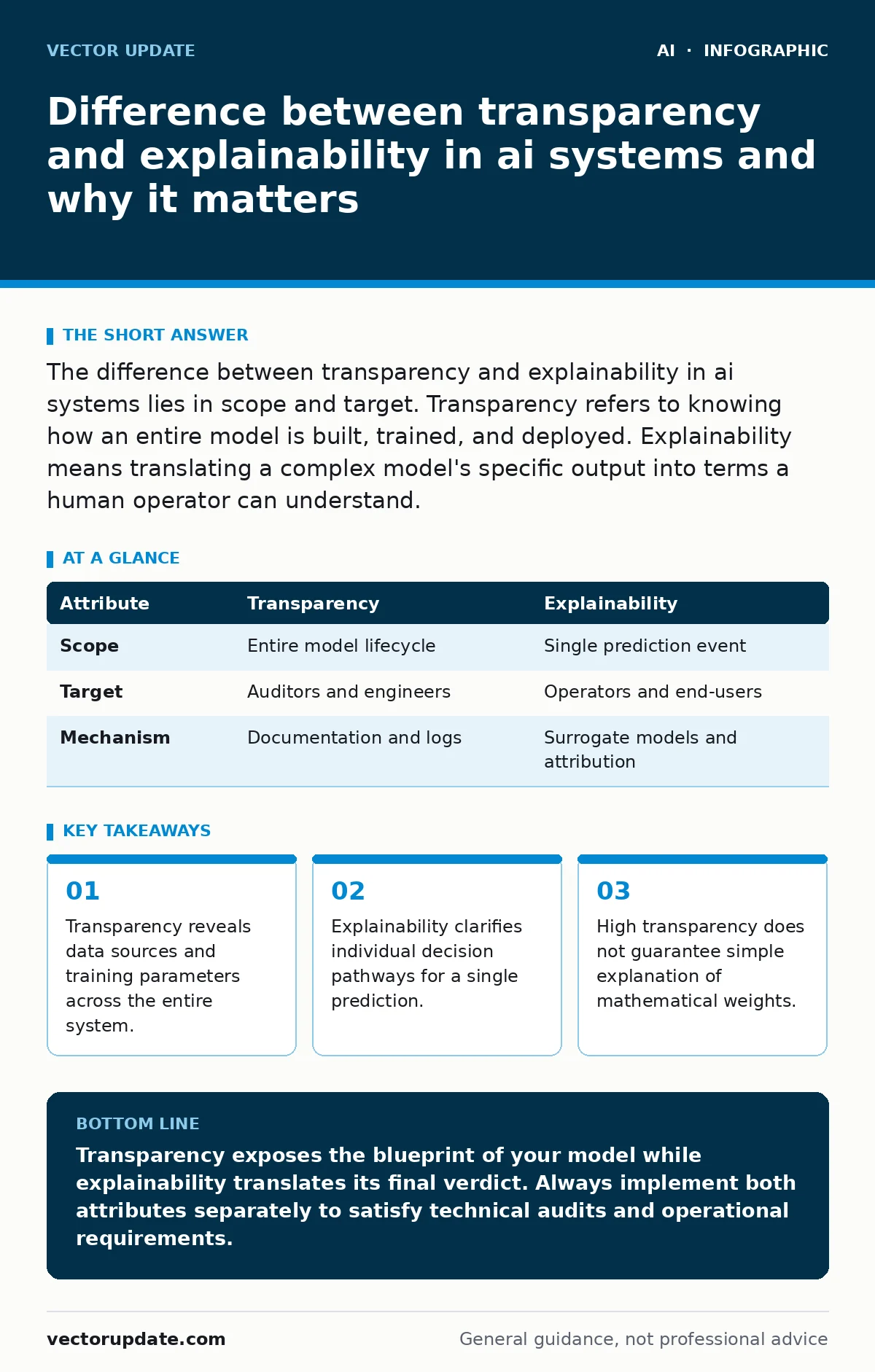
The difference between transparency and explainability in ai systems lies in scope and target. Transparency refers to knowing how an entire model is built, trained, and deployed. Explainability means translating a complex model's specific output into terms a human operator can understand.
What is the difference between transparency and explainability in ai systems?
The difference between transparency and explainability in ai systems centers on visibility versus interpretation. Transparency grants you full access to training data, hyper-parameters, architecture choices, and codebase documentation. Explainability provides human-understandable reasoning for a specific machine output without necessarily exposing the underlying internal mechanics.
Operationalizing these concepts requires distinct tooling and architectural patterns. Systems built for transparency expose their internal states directly to auditors and logging facilities. Systems built for explainability rely on auxiliary algorithms that approximate complex behaviors using simpler, readable rules.
Why does total transparency fail to clarify individual predictions?
Total transparency fails to clarify individual predictions because knowing every line of code does not explain multidimensional vector math. Viewing the complete architecture of a deep neural network leaves you staring at billions of floating-point weights.
Machine learning for fraud detection often suffers from this exact paradox where engineers possess the complete training pipeline yet cannot trace why a specific transaction triggered an alert. Complete visibility into source code and training sets provides zero insight into how millions of parameters interact during inference.
How do complex neural networks obscure decision pathways?
Complex neural networks obscure decision pathways through non-linear transformations distributed across numerous hidden layers. Each layer abstracts features further from the raw input, turning simple pixel values or text tokens into abstract geometric representations.
Feature importance shifts constantly depending on subtle interactions between unrelated inputs. Tracing a single output back through these cascading transformations requires mathematical approximations rather than exact tracking.
| Attribute | Transparency | Explainability |
|---|---|---|
| Scope | Entire model lifecycle | Single prediction event |
| Target | Auditors and engineers | Operators and end-users |
| Mechanism | Documentation and logs | Surrogate models and attribution |
What trade-offs emerge when you choose accuracy over interpretability?
Accuracy demands massive parameter counts that inherently destroy human interpretability. Linear models remain wonderfully explainable because every input maps directly to a fixed coefficient, but they fail to capture subtle patterns in unstructured data.
Neural networks capture intricate patterns by sacrificing linear accountability. Choosing maximum predictive performance forces you to accept a complete loss of intuitive cause-and-effect reasoning inside the core engine.
When do regulatory frameworks require both attributes simultaneously?
Regulatory frameworks require both attributes simultaneously whenever automated decisions impact human rights, credit access, or legal standing. Auditors evaluate AI governance programs by demanding documentation of training data provenance alongside verifiable reasoning for denied applications.
Complying with these mandates means maintaining comprehensive documentation while deploying runtime interpretation layers. Neither attribute substitutes for the other during a formal compliance audit.
How can you audit black-box models without source code access?
Auditing black-box models without source code access relies on systematic perturbation testing and surrogate modeling. Feeding modified inputs into the system and observing the resulting output changes reveals which features carry the highest mathematical weight.
Trainers build local linear approximations around specific predictions to mimic the black-box behavior within a narrow boundary. Responsible AI practices dictate that you treat these approximations as estimates rather than absolute proof of internal logic.
What hidden operational costs accompany advanced interpretation tools?
Advanced interpretation tools introduce massive computational overhead and latency penalties into production pipelines. Calculating attribution scores for every single inference can double or triple the compute resources required to serve requests.
Engineering teams must also manage access controls for AI agents that generate and store sensitive explanation logs. Exposing internal decision pathways can inadvertently leak proprietary training features to unauthorized observers.
Key takeaways
- Transparency reveals data sources and training parameters across the entire system.
- Explainability clarifies individual decision pathways for a single prediction.
- High transparency does not guarantee simple explanation of mathematical weights.
Transparency exposes the blueprint of your model while explainability translates its final verdict. Always implement both attributes separately to satisfy technical audits and operational requirements.
Frequently asked questions
Can an opaque model ever be considered transparent?
No, an opaque model hides its architecture and training data, which directly violates the core definition of transparency.
Do decision trees require separate explainability tools?
Decision trees remain inherently interpretable because you can read the split paths directly without needing auxiliary explanation algorithms.
How do features interact to break linear explanations?
Features combine non-linearly when one input multiplies or alters the weight of another input further down the network layers.
What is the primary risk of using surrogate models?
Surrogate models can fail catastrophically when applied to edge cases that differ significantly from the training data distribution.
How this guide was produced: written by the Vector Update editorial team with AI assistance, checked against the public references listed below, and reviewed when the facts change. See our editorial policy or report an error.