Deepfake detection defined: how synthetic media verification works
Synthetic media analysis relies on hunting invisible mathematical inconsistencies rather than spotting blurry edges.

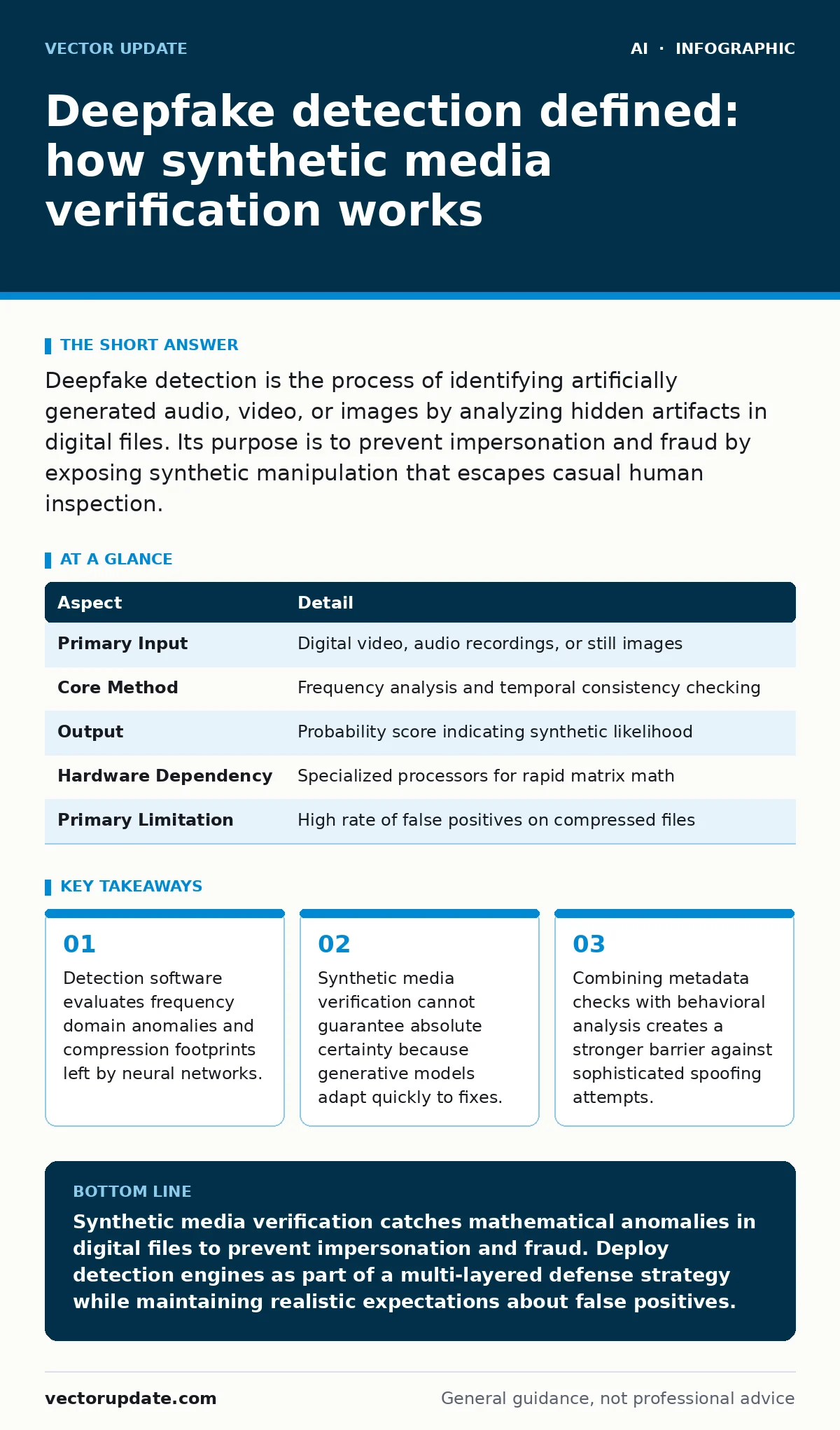
Deepfake detection is the process of identifying artificially generated audio, video, or images by analyzing hidden artifacts in digital files. Its purpose is to prevent impersonation and fraud by exposing synthetic manipulation that escapes casual human inspection.
Understanding Synthetic Media Impersonation
Fake audio and video resemble counterfeit currency printed on high-end office machines rather than crude hand-drawn notes. Genuine digital captures record light and sound through physical lenses and diaphragms, creating natural noise patterns and optical imperfections. Synthetic media generation relies on mathematical models that synthesize pixels or waveform samples from scratch, often leaving subtle mathematical fingerprints behind.
Artifacts in generated content stem from the blending boundaries where neural networks stitch synthesized facial regions onto source footage. Blending algorithms struggle with lighting consistency, temporal stability, and anatomical alignment across consecutive frames. These flaws remain invisible to human eyes during normal playback speeds but stand out clearly under algorithmic scrutiny.
The Core Mechanics of Detection Engines
Frequency domain analysis exposes synthetic generation by converting spatial pixel values into mathematical wave representations. Genuine camera sensors capture high-frequency noise distributed evenly across an image frame, while generative algorithms often smooth out these fine details. Detecting this mismatch requires Fourier transforms or discrete cosine transformations to reveal unnatural smoothness in high-frequency bands.
Temporal consistency checks evaluate how pixels change across multiple frames of video to catch jitter and flickering. Real human movement follows biological laws of momentum and muscle contraction that basic generative models approximate rather than simulate accurately. Tracking micro-expressions, blink rates, and pulse-induced color shifts in skin tones exposes discrepancies that single-frame image classifiers miss entirely.
Anatomy of Verification Systems
| Aspect | Detail |
|---|---|
| Primary Input | Digital video, audio recordings, or still images |
| Core Method | Frequency analysis and temporal consistency checking |
| Output | Probability score indicating synthetic likelihood |
| Hardware Dependency | Specialized processors for rapid matrix math |
| Primary Limitation | High rate of false positives on compressed files |
Input ingestion pipelines accept raw media files and split them into individual frames or audio segments for parallel processing. Feature extraction modules isolate regions most prone to generation errors, such as eyes, teeth, and mouth interiors. Classification engines compare extracted features against trained models to generate a numeric score representing the probability of manipulation.
Where Verification Fits in Modern Security Architecture
Verification tools operate as supplementary gates within larger identity management and content ingestion workflows. Integrating these checks into onboarding portals helps block automated presentation attacks before accounts are created. Network edge devices can scan incoming media streams in real time, flagging suspicious video feeds during remote conferences or verification calls.
Preventing identity fraud requires more than a single detection layer because attackers constantly refine their generative pipelines. Combining automated media analysis with out-of-band challenge mechanisms ensures that a single bypassed check does not compromise the entire system. Security teams should pair deepfake detection with machine learning for fraud detection to catch broader behavioral anomalies alongside manipulated media.
Common Misconceptions About Synthetic Media Scers
Believing that human reviewers can reliably spot manipulated media creates a false sense of security during critical verification tasks. High-definition generation tools render visual flaws nearly imperceptible to even trained investigators working without specialized analysis software. Relying on visual inspection alone invites social engineering attacks that exploit human trust during high-stakes video calls.
Expecting detection tools to provide permanent protection misunderstands the continuous arms race between generative models and classifiers. Every time a detection model learns to spot a specific neural network artifact, developers update their generative pipelines to eliminate that exact flaw. Security systems require continuous retraining and diverse datasets to maintain effectiveness against newly released synthesis techniques.
See also: Synthetic Media Defined: What It Is and How It Works · Difference between transparency and explainability in ai systems and why it matters
Hidden Costs and Operational Trade-offs
Processing high-resolution video streams through deep neural networks demands substantial computational power and specialized accelerator hardware. Latency introduced by thorough frame-by-frame analysis can disrupt real-time communication tools where users expect instantaneous audio and video feedback. Balancing detection thoroughness against acceptable processing delay forces administrators to compromise on frame sampling rates or resolution limits.
False positives impose significant operational friction by flagging legitimate media captured under unusual lighting or heavy digital compression. Compressing video for transmission across bandwidth-constrained networks strips away the very high-frequency artifacts that detection algorithms rely upon for identification. This data degradation forces defenders to choose between strict security thresholds that block valid users and lenient settings that permit sophisticated attacks.
Key takeaways
- Detection software evaluates frequency domain anomalies and compression footprints left by neural networks.
- Synthetic media verification cannot guarantee absolute certainty because generative models adapt quickly to fixes.
- Combining metadata checks with behavioral analysis creates a stronger barrier against sophisticated spoofing attempts.
Synthetic media verification catches mathematical anomalies in digital files to prevent impersonation and fraud. Deploy detection engines as part of a multi-layered defense strategy while maintaining realistic expectations about false positives.
Frequently asked questions
Can deepfake detection run in real time during a live video call?
Real-time detection is possible, but it requires substantial computing power and often samples only a fraction of incoming frames to reduce latency.
Why do highly compressed videos break detection algorithms?
Compression removes the fine-grained high-frequency noise patterns and pixel-level details that detectors rely upon to identify synthetic manipulation.
How often do detection models need updating?
Models require frequent updates because generative techniques evolve rapidly to eliminate the specific artifacts that older classifiers target.
Does deepfake detection work on audio-only recordings?
Audio detection works by analyzing phase consistency and unnatural spectral patterns, though it faces similar challenges with telephony compression.
How this guide was produced: written by the Vector Update editorial team with AI assistance, checked against the public references listed below, and reviewed when the facts change. See our editorial policy or report an error.