Detecting deepfake fraud: what systems and logs actually reveal
Synthetic media leaves traces in transmission buffers, metadata, and behavioral anomalies that standard security tools miss entirely.

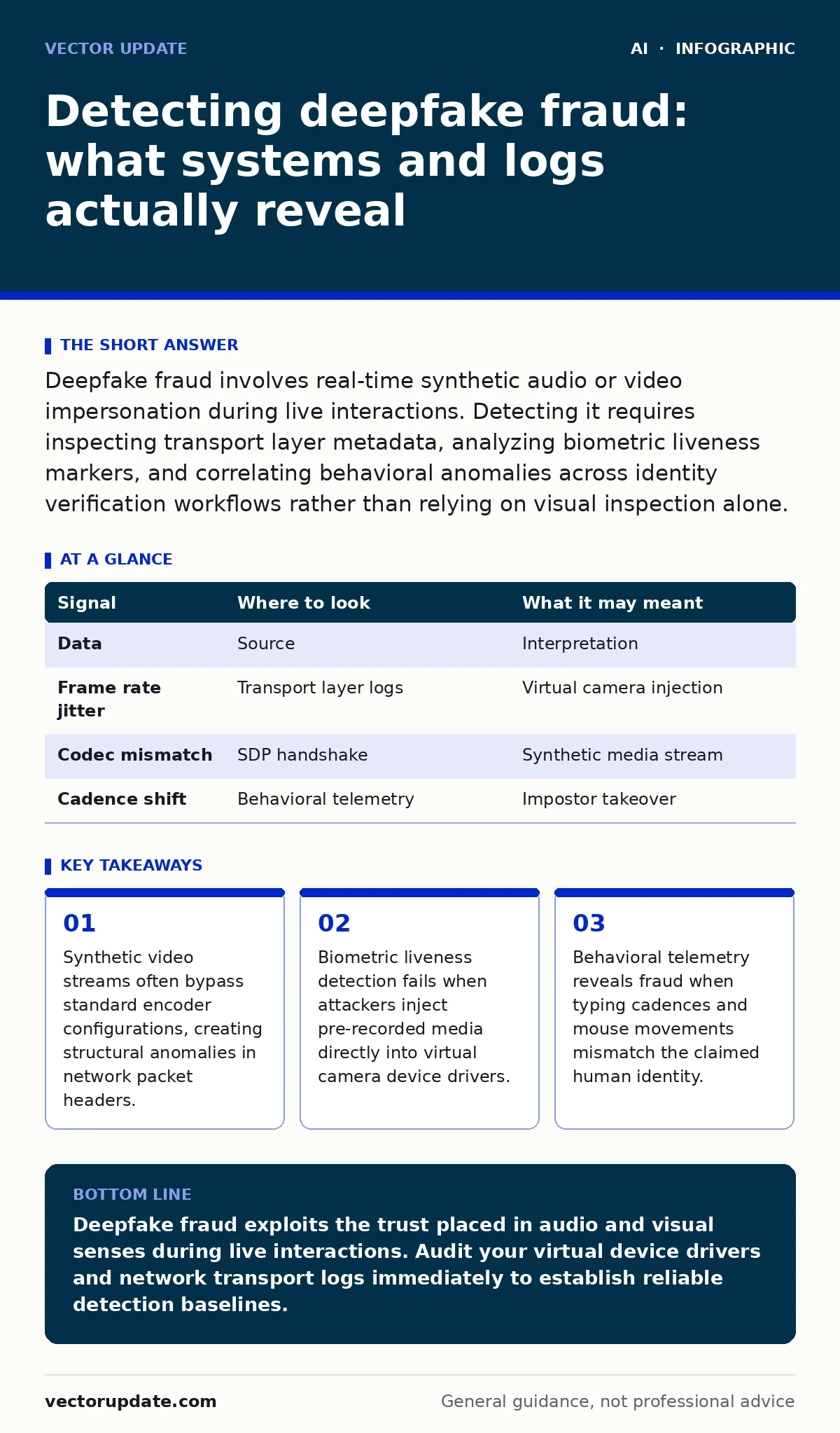
Deepfake fraud involves real-time synthetic audio or video impersonation during live interactions. Detecting it requires inspecting transport layer metadata, analyzing biometric liveness markers, and correlating behavioral anomalies across identity verification workflows rather than relying on visual inspection alone.
Inspecting transport layer metadata and codecs
Network packet inspection reveals anomalies in synthetic media streams that human eyes and ears miss during live calls. Attackers routing generated video through virtual devices often misconfigure standard video codecs, leaving distinctive markers in the Session Description Protocol handshake. Transport layer logs show unusual frame rate jitter and missing metadata fields that native conferencing hardware normally generates automatically.
Virtual camera drivers inject synthetic feeds directly into operating system media pipelines without physical sensor interaction. Operating system logs capture these unauthorized driver insertions when kernel-level auditing tracks device enumeration events. System administrators must monitor peripheral initialization logs to catch unauthorized video inputs before conferencing applications render the stream.
Analyzing biometric liveness markers
Biometric liveness detection systems evaluate physiological responses to challenge-response prompts during authentication events. Synthetic video generators struggle to replicate natural micro-expressions, pulse-induced skin color variations, and accurate depth perception cues in real time. Analyzing high-frequency luminance changes across facial regions exposes temporal inconsistencies unique to generative models.
False positives occur frequently when genuine users experience poor network bandwidth or low-resolution webcams. Compression artifacts mimic the blurring effects of generative models, causing security controls to flag legitimate participants as synthetic impostors. Balancing strict verification thresholds with user experience requires fallback authentication mechanisms that do not rely solely on visual analysis.
Correlating behavioral telemetry and typing cadences
Behavioral biometrics measure how users interact with hardware peripherals during digital sessions. Fraudsters using deepfakes often fail to replicate the unique typing cadences, mouse acceleration curves, and navigation habits of the compromised identity. Identity verification workflows must continuously ingest this telemetry to flag discrepancies between the claimed profile and physical interaction patterns.
Machine learning for fraud detection helps process these continuous behavioral signals without adding friction to authentic user journeys. Baseline models establish normal interaction patterns over weeks of usage, allowing systems to detect sudden shifts in user behavior instantly. This approach remains effective even when visual and auditory impersonations achieve high fidelity.
| Signal | Where to look | What it may meant |
|---|---|---|
| Data | Source | Interpretation |
| Frame rate jitter | Transport layer logs | Virtual camera injection |
| Codec mismatch | SDP handshake | Synthetic media stream |
| Cadence shift | Behavioral telemetry | Impostor takeover |
Recognizing common operational blind spots
Security teams often focus entirely on the application layer while ignoring the underlying operating system infrastructure. Attackers exploit virtual device APIs that bypass application-level checks entirely, feeding synthetic streams straight into the browser rendering engine. Endpoint monitoring must extend to media device enumeration to catch these bypass techniques early.
Another significant blind spot involves relying on static visual inspection training for employees handling sensitive verification tasks. Human perception fails against modern generative models that operate with low latency and high resolution. Organizations must implement automated detection layers that evaluate network transport properties rather than trusting human judgment during high-stakes authorization requests.
Investigating audio synthesis and channel characteristics
Audio deepfakes exhibit distinct spectral signatures in the frequency domain due to the limitations of neural vocoders. Network logs capture abnormal audio packet pacing and unexpected sample rate conversions during active communication sessions. Audio streams generated by AI models often lack the high-frequency background noise floor present in natural acoustic environments.
Signal processing tools analyze these acoustic anomalies by measuring phase coherence and spectral continuity across audio channels. Integrating these checks into telephony infrastructure helps intercept audio-only fraud attempts before authorization decisions occur.
See also: Deepfake detection defined: how synthetic media verification works
Maintaining defenses against evolving generation techniques
Generative models improve continuously, reducing the reliability of static signatures and visual heuristics. Security architectures must adapt by treating all media streams as untrusted inputs that require multi-factor corroboration. Establishing robust internal controls through responsible AI practices ensures that defensive algorithms do not perpetuate systemic biases while hunting for synthetic artifacts.
Preventing sophisticated impersonation attacks requires defending underlying infrastructure rather than chasing visual imperfections. Synthetic media generation will continue to advance, making transport layer verification and behavioral correlation the primary bulwarks against modern impersonation attempts.
Key takeaways
- Synthetic video streams often bypass standard encoder configurations, creating structural anomalies in network packet headers.
- Biometric liveness detection fails when attackers inject pre-recorded media directly into virtual camera device drivers.
- Behavioral telemetry reveals fraud when typing cadences and mouse movements mismatch the claimed human identity.
Deepfake fraud exploits the trust placed in audio and visual senses during live interactions. Audit your virtual device drivers and network transport logs immediately to establish reliable detection baselines.
Frequently asked questions
Can standard antivirus software detect deepfake generation software running on an endpoint?
Standard antivirus tools typically miss deepfake generation software because these tools often rely on legitimate libraries and virtual device drivers rather than malicious code payloads. Detection requires monitoring device enumeration logs and application behavior rather than relying on signature-based malware scanning.
How do attackers bypass physical webcam requirements during authentication?
Attackers use virtual camera software to feed pre-recorded or dynamically generated video streams directly into the operating system media pipeline, tricking conferencing applications into treating the synthetic feed as a physical hardware input.
What is the primary difference between detecting deepfakes in real-time calls versus static files?
Real-time detection depends on analyzing transport layer metadata, frame rate consistency, and network jitter under strict latency constraints, whereas static file analysis allows for deep spatial and temporal artifact inspection over longer processing windows.
Do hardware acceleration units leave logs when used for deepfake generation?
Graphics processing unit utilization logs and kernel-level resource allocation monitors record high memory bandwidth usage and sustained compute spikes when local models generate synthetic media streams.
How this guide was produced: written by the Vector Update editorial team with AI assistance, checked against the public references listed below, and reviewed when the facts change. See our editorial policy or report an error.