Biometric Data Definition: How Identity Templates Create Permanent Risk
Biometric data creates a permanent identity record that cannot be changed like a password, turning every scan into a potential lifelong liability.
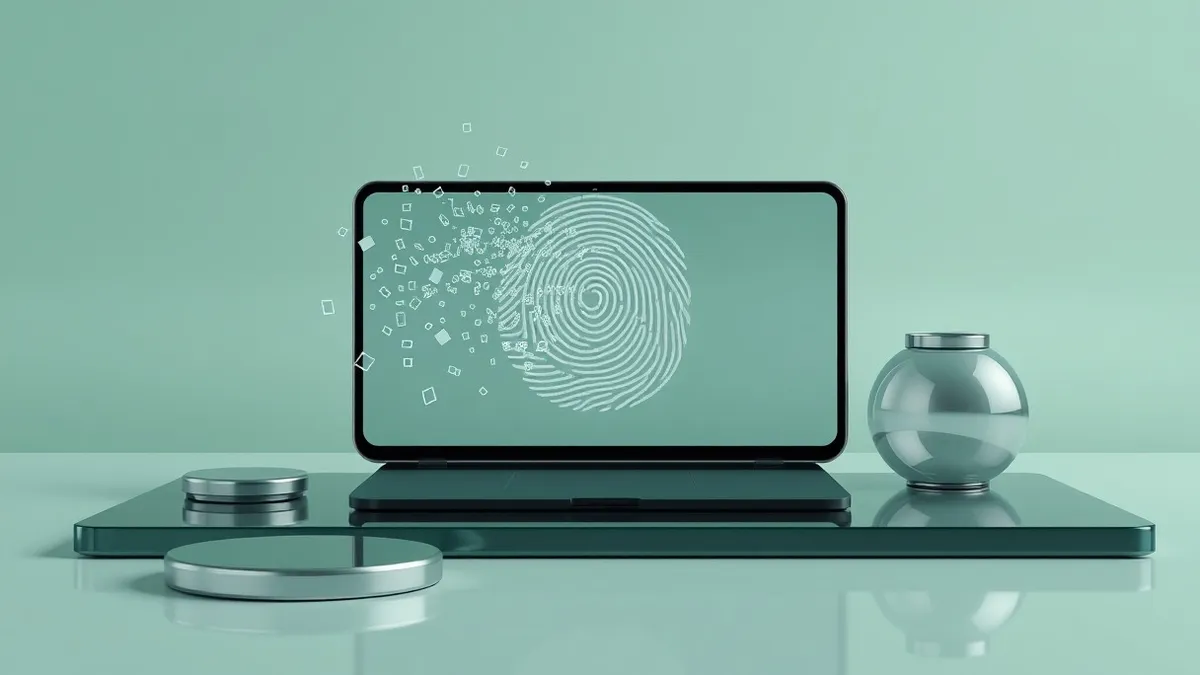
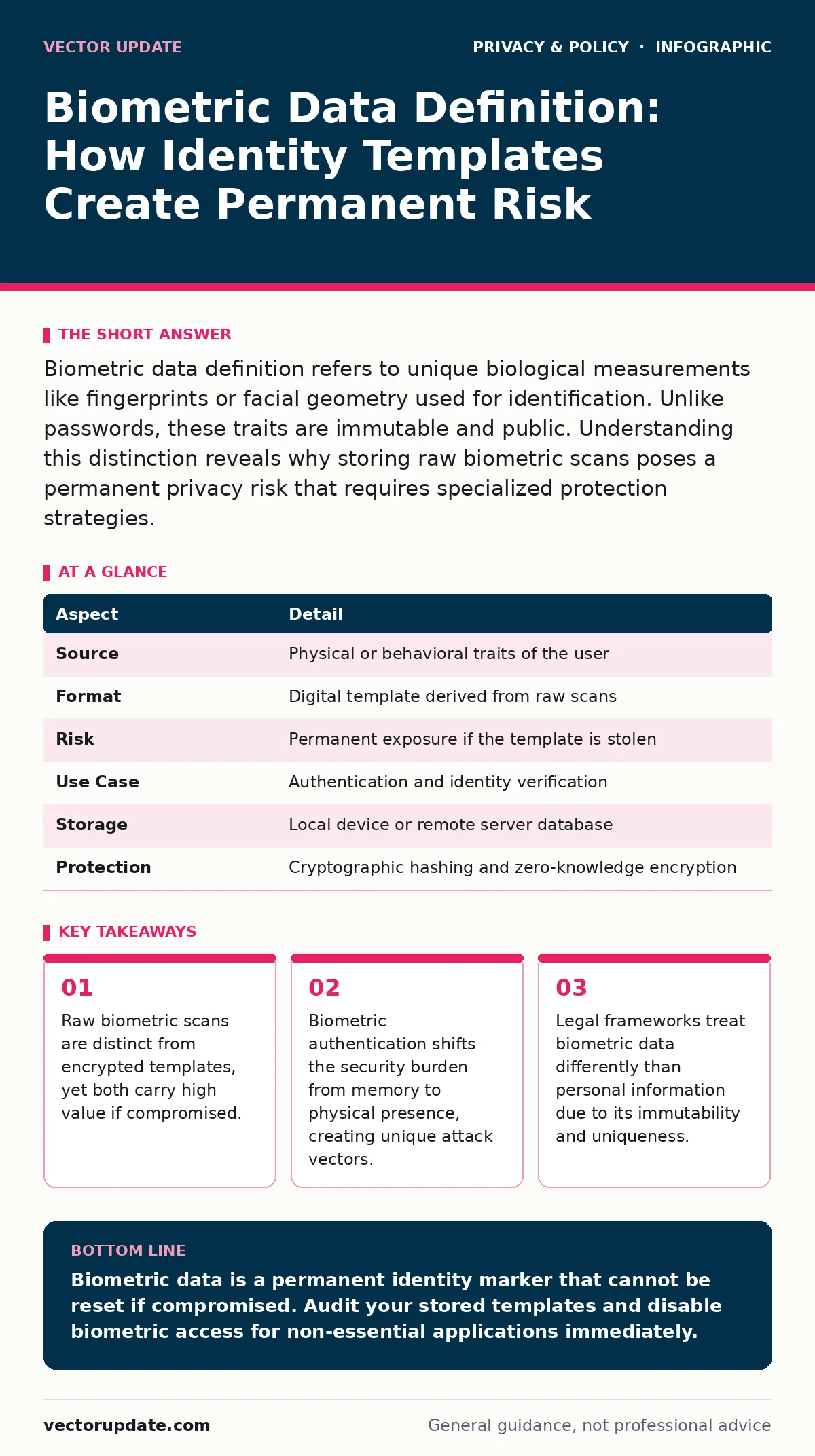
Biometric data definition refers to unique biological measurements like fingerprints or facial geometry used for identification. Unlike passwords, these traits are immutable and public. Understanding this distinction reveals why storing raw biometric scans poses a permanent privacy risk that requires specialized protection strategies.
What is the biometric data definition?
Biometric data definition refers to measurable biological characteristics that uniquely identify a person. These traits include fingerprints, iris patterns, facial geometry, and voice prints. The system captures a physical sample and converts it into a digital representation. This representation serves as a key to unlock devices or verify identity. The core difference between this data and a password is immutability. You can change a password instantly. You cannot change your face or your fingerprint. This permanence changes the risk profile entirely.
At a glance: Biometric Data Basics
| Aspect | Detail |
|---|---|
| Source | Physical or behavioral traits of the user |
| Format | Digital template derived from raw scans |
| Risk | Permanent exposure if the template is stolen |
| Use Case | Authentication and identity verification |
| Storage | Local device or remote server database |
| Protection | Cryptographic hashing and zero-knowledge encryption |
How biometric systems process identity
The process begins with capture. A sensor records a physical trait. This raw image or audio file is large and inefficient. The system processes this input to extract specific features. For a fingerprint, it maps ridge endings and bifurcations. For a face, it measures distances between eyes, nose, and jaw. These measurements create a mathematical template. This template is a one-way function. You cannot reconstruct the original fingerprint from the template. The system stores this template, not the raw image. When you authenticate, the system creates a new template from your current scan and compares it to the stored one. A match grants access.
Who is affected by biometric collection
Every person who uses smartphone unlocking is affected. Retail stores that scan palms for payment are affected. Employers who use facial recognition for time tracking are affected. The impact extends beyond the user. Family members who appear in background photos may have their data collected without consent. This is known as secondary collection. You cannot opt out of being scanned in a crowded street if cameras are present. The data trails persist indefinitely. Even if you delete your account, the biometric data may remain in backup systems or third-party caches. This creates a permanent record of your physical presence.
What people usually get wrong
Many users believe biometric data is just another password. This misconception leads to poor security hygiene. A password is a secret known only to you. Your face is a secret known to everyone who sees you. You leave fingerprints on every surface you touch. Your face is visible on social media photos. This public availability means the "secret" is already compromised.
The security relies entirely on the quality of the template and the storage method. Another common error is assuming local storage is perfectly safe. If the device is lost, the template is exposed. If the manufacturer backs up the template to the cloud, the local security model fails. You must understand where the data lives.
See also: Password Spraying Attacks: How They Work and How to Stop Them
The hidden cost of convenience
Convenience drives biometric adoption. Unlocking a phone with a glance is faster than typing a code. This speed creates a false sense of security. Users stop thinking about authentication. They stop verifying who is asking for access. This behavioral shift increases social engineering risk. An attacker does not need to hack the system. They only need to coerce you into looking at a device. Duress attacks become easier. You cannot claim you forgot your password if your face is always with you. The system has no way to know if you are being forced to authenticate. This removes a layer of protection that passwords provide.
Managing biometric data risks
You can reduce risk by understanding the storage architecture. Prefer systems that store templates on the device, not in the cloud. This limits the blast radius of a server breach. Check if the service uses zero-knowledge encryption. This ensures the provider cannot view your raw data. Use digital privacy rights to request deletion of stored templates. Many jurisdictions allow you to demand the removal of biometric records. Be cautious with parental controls that rely on biometrics for children. Children’s biometric data changes as they grow. A template created at age 10 may not work at age 15. This leads to repeated collection and larger data footprints.
When biometric advice fails
Standard advice tells you to keep your device secure. This fails when the sensor itself is the vulnerability. Some sensors can be tricked by high-resolution photos or synthetic materials. This is a hardware limitation, not a user error. You cannot patch a sensor that is easily fooled. Another failure point is the legal framework. Laws often lag behind technology.
A breach may not trigger notification requirements if the data was "anonymized." But biometric data is rarely truly anonymized. It is inherently linked to a specific body. Differential privacy techniques add noise to data sets to protect individuals, but they are not always applied to individual authentication templates. You must assume your biometric data is unique and identifiable.
Protecting your biological identity
Treat biometric data as a high-value asset. Do not share raw scans with untrusted services. Use encrypted email for sensitive communications that might contain biometric documents. Avoid using the same biometric trait for high-security and low-security applications. If your phone is unlocked by fingerprint, do not use that same fingerprint to sign legal contracts.
Compartmentalize your identity. If one system is breached, the others remain safe. Monitor for breaches involving biometric databases. These breaches are rarely publicized immediately. Stay informed about digital privacy rights in your region. Know how to opt out of collection. Your biological data is yours. Protect it with the same rigor as your financial credentials.
Key takeaways
- Raw biometric scans are distinct from encrypted templates, yet both carry high value if compromised.
- Biometric authentication shifts the security burden from memory to physical presence, creating unique attack vectors.
- Legal frameworks treat biometric data differently than personal information due to its immutability and uniqueness.
Biometric data is a permanent identity marker that cannot be reset if compromised. Audit your stored templates and disable biometric access for non-essential applications immediately.
Frequently asked questions
Can biometric data be anonymized?
True anonymization is nearly impossible for biometric data because the traits are inherently unique to an individual. Techniques like differential privacy can reduce identifiability in large datasets, but they do not remove the link to the source in authentication systems.
Is facial recognition the same as facial detection?
No. Facial detection identifies a face in an image. Facial recognition maps specific features to a stored template to identify a specific person. Detection is common in cameras. Recognition requires a database of identities.
What happens if my biometric data is stolen?
You cannot change your fingerprint or face. You must revoke access to all services using that trait. This may require resetting devices and accounts. The stolen data can be used to create synthetic identities or forge authentication attempts.
Do companies keep my biometric data forever?
Many companies retain data longer than necessary for legal or operational reasons. You should request deletion after your account is closed. Check the privacy policy to understand retention periods. Some jurisdictions mandate deletion upon request.
How this guide was produced: written by the Vector Update editorial team with AI assistance, checked against the public references listed below, and reviewed when the facts change. See our editorial policy or report an error.