OAuth vs OIDC: The Structural Difference for Secure Identity
OAuth handles authorization for resources while OIDC adds an identity layer on top, meaning you cannot verify who a user is with OAuth alone.
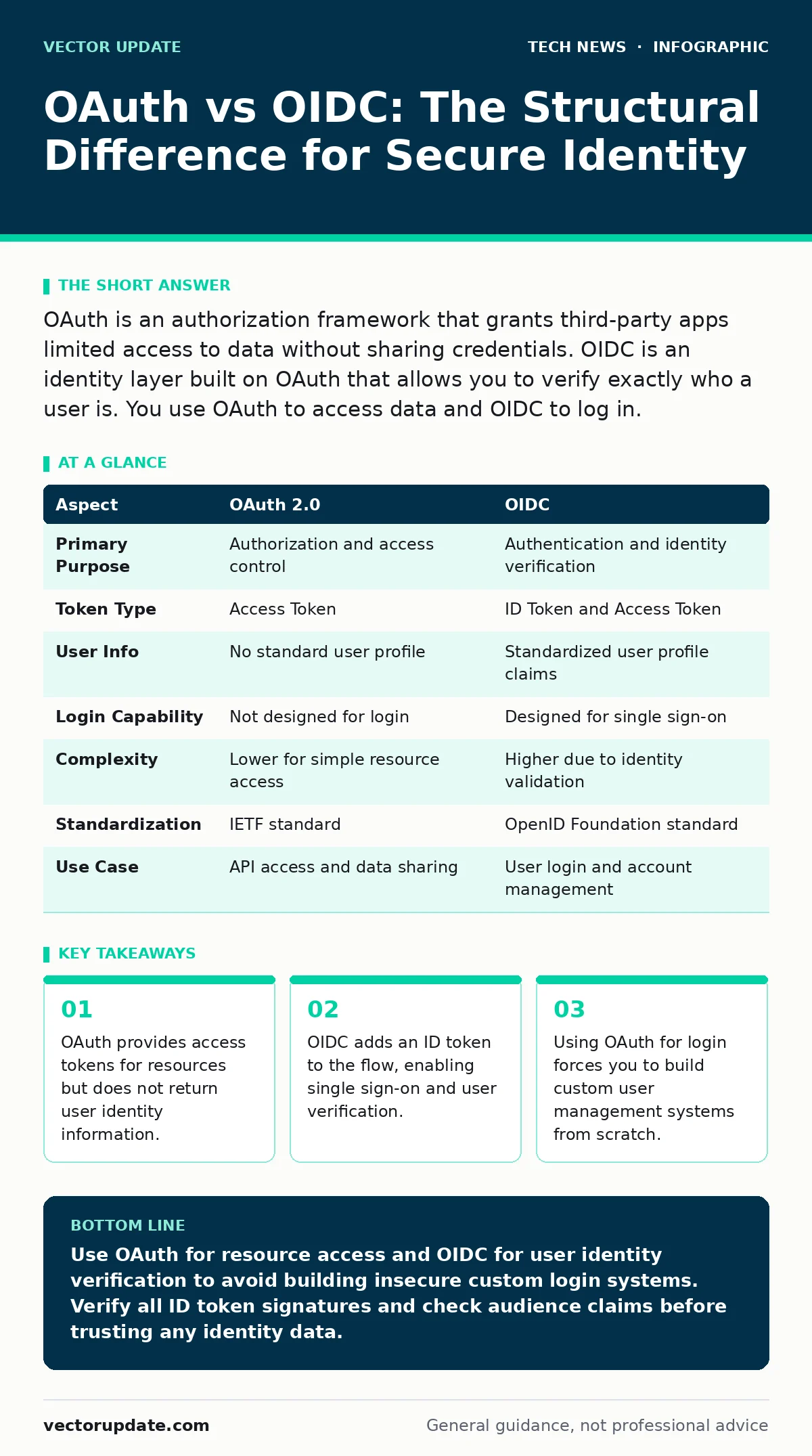
OAuth is an authorization framework that grants third-party apps limited access to data without sharing credentials. OIDC is an identity layer built on OAuth that allows you to verify exactly who a user is. You use OAuth to access data and OIDC to log in.
OAuth vs OIDC: The Core Distinction
OAuth and OIDC are often confused because OIDC is built directly on top of OAuth. OAuth is strictly an authorization framework. It allows one application to request access to a resource on behalf of a user. It answers the question of what data can be accessed. OIDC is an identity layer. It uses the OAuth 2.0 flow to authenticate a user and return a standardized ID token. It answers the question of who the user is. You cannot use OAuth alone to perform secure login.
What OAuth Actually Does
OAuth enables delegated authorization. Imagine a calendar app that needs to read your schedule. You do not want to give that app your email password. OAuth lets you grant the calendar app a specific permission. The app receives an access token. This token allows the app to talk to your email provider. The provider checks the token and allows the request. The app never sees your password. The scope is limited. The token expires. This mechanism keeps your primary credentials safe while allowing third-party integrations.
What OIDC Adds to the Flow
OIDC adds identity verification to the authorization flow. When you log in with OIDC, the provider returns an ID token. This token contains claims about the user. Claims include the user ID, email address, and name. The application verifies the signature of this token. This proves the identity information came from the trusted provider. You do not need to build a user database. You do not need to manage password resets. The provider handles the identity. The application trusts the provider. This reduces the attack surface significantly.
Point-by-Point Comparison
| Aspect | OAuth 2.0 | OIDC |
|---|---|---|
| Primary Purpose | Authorization and access control | Authentication and identity verification |
| Token Type | Access Token | ID Token and Access Token |
| User Info | No standard user profile | Standardized user profile claims |
| Login Capability | Not designed for login | Designed for single sign-on |
| Complexity | Lower for simple resource access | Higher due to identity validation |
| Standardization | IETF standard | OpenID Foundation standard |
| Use Case | API access and data sharing | User login and account management |
When to Choose OAuth
Choose OAuth when you need to grant access to data without managing users. You are building an integration. Another system needs to read or write data on your behalf. You do not care who the user is. You only care that the request is authorized. This is common for background jobs. It is common for machine-to-machine communication. You need a way to limit permissions. You need a way to revoke access. OAuth provides the structure for this. It does not provide user profiles. It does not provide login screens.
See also: Cloud Landing Zones: Definition, Purpose, and Core Architecture · Login Alerts Explained: Why Noise Drowns Out Real Threats
When to Choose OIDC
Choose OIDC when you need to know who the user is. You are building a login screen. You want to offer single sign-on. You want to avoid storing passwords. You want to leverage existing identity providers. OIDC gives you a verified user ID. It gives you email and name data. It handles the session management. It reduces the burden on your infrastructure. You rely on the provider for security. You focus on your application logic. This is the standard for modern web applications. It aligns with public key infrastructure for verifying signatures.
Where They Overlap
OIDC uses OAuth 2.0 for its transport mechanism. The authorization code flow is the same. The token endpoint is the same. The scopes are similar. OIDC adds the openid scope. This scope requests the ID token. If you implement OIDC, you are already implementing OAuth. You cannot have OIDC without OAuth. You can have OAuth without OIDC. Most providers support both. They often use the same configuration. The difference is in the response. OAuth returns only an access token. OIDC returns an ID token and an access token.
Implementation Considerations
Security depends on correct implementation. You must validate the ID token signature. You must check the audience claim. You must check the issuer claim. You must check the expiration time. Failure to do any of these allows token forgery. Tokens can be stolen. Tokens can be replayed. Always use TLS handshake for transport security. This prevents interception of tokens. Store tokens securely. Do not log tokens. Rotate secrets regularly. Monitor for unusual activity. This reduces the risk of compromise. It aligns with DevOps security principles.
Common Misconceptions
Many believe OAuth can handle login. It cannot. The access token is for resources. It is not for identity. Many believe OIDC replaces OAuth. It does not. OIDC extends OAuth. Many believe they are separate products. They are standards. Many believe one is more secure. Security depends on implementation. Both can be secure. Both can be insecure. The choice depends on the requirement. Do you need access or identity? Answer that first. Then choose the standard. This simplifies the architecture. It reduces technical debt. It improves user experience.
Key takeaways
- OAuth provides access tokens for resources but does not return user identity information.
- OIDC adds an ID token to the flow, enabling single sign-on and user verification.
- Using OAuth for login forces you to build custom user management systems from scratch.
Use OAuth for resource access and OIDC for user identity verification to avoid building insecure custom login systems. Verify all ID token signatures and check audience claims before trusting any identity data.
Frequently asked questions
Can I use OAuth for single sign-on?
No. OAuth does not provide a standard way to verify user identity. You must use OIDC for single sign-on.
Is OIDC more secure than OAuth?
OIDC is not inherently more secure. It adds identity features. Security depends on correct implementation of both standards.
Do I need both OAuth and OIDC?
OIDC includes OAuth. If you use OIDC, you are using OAuth. You do not need to implement them separately.
What happens if an ID token expires?
The application must re-authenticate the user. You can use refresh tokens to obtain new tokens without user interaction.
How this guide was produced: written by the Vector Update editorial team with AI assistance, checked against the public references listed below, and reviewed when the facts change. See our editorial policy or report an error.