Cybercrime Forums: How Market Data Improves Security Decisions
Criminal marketplaces reveal the exact cost and availability of tools before attackers deploy them against your infrastructure.
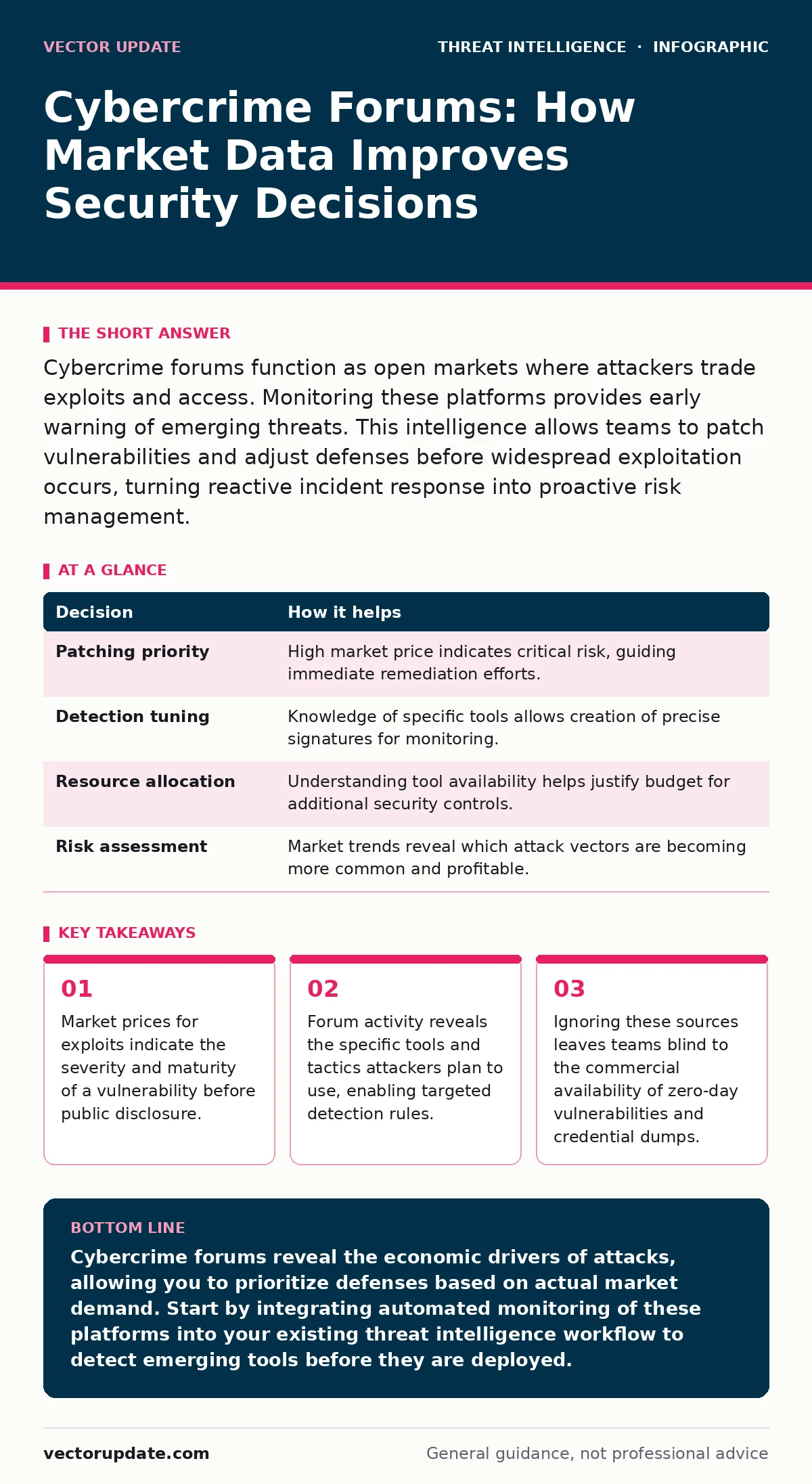
Cybercrime forums function as open markets where attackers trade exploits and access. Monitoring these platforms provides early warning of emerging threats. This intelligence allows teams to patch vulnerabilities and adjust defenses before widespread exploitation occurs, turning reactive incident response into proactive risk management.
Understanding the Commercial Nature of Attacks
Cybercrime forums are not random chat rooms. They are structured marketplaces with reputation systems, escrow services, and strict moderation. Attackers treat malware and exploits as commodities. You can observe the supply chain of an attack before it reaches your network. Understanding this commercial dynamic changes how you view threat intelligence. It shifts the focus from abstract risks to concrete, priced assets.
These platforms host discussions on zero-day vulnerabilities, which are flaws unknown to the vendor. They also trade exploit kits, which are software packages that automate the delivery of malware. By observing these markets, you see which vulnerabilities are considered valuable. High-value items attract more attention and better development resources. This economic reality drives the evolution of attack techniques.
The Economic Signal of Vulnerability Severity
Price is a reliable indicator of threat severity. If a vulnerability commands a high price, it is likely critical and difficult to patch. Low prices often indicate older, well-known flaws or tools with limited effectiveness. Tracking these prices helps you prioritize your patching efforts. You do not need to fix every bug immediately. You should fix the ones attackers are willing to pay for.
Imagine a new vulnerability appears. The initial price is high because few copies exist. As more attackers acquire it, the price drops. This price drop signals mass adoption. Your security team can use this trend to predict when widespread exploitation will begin. This timeline allows you to prepare detection rules and incident response plans.
| Decision | How it helps |
|---|---|
| Patching priority | High market price indicates critical risk, guiding immediate remediation efforts. |
| Detection tuning | Knowledge of specific tools allows creation of precise signatures for monitoring. |
| Resource allocation | Understanding tool availability helps justify budget for additional security controls. |
| Risk assessment | Market trends reveal which attack vectors are becoming more common and profitable. |
Operationalizing Forum Intelligence
Teams use this data to refine their defensive posture. Analysts monitor forum posts for mentions of specific software or services. They look for discussions about bypassing security controls. This information feeds into YARA rules, which are pattern-matching rules used to identify and classify malware. Custom rules based on forum intel are more effective than generic signatures.
You can also identify new bulletproof hosting providers. These are hosting services that ignore abuse reports. Attackers use them to host command and control servers. Knowing which providers are popular in forums helps you block traffic to those networks. This reduces the chance of your systems communicating with malicious infrastructure. It is a proactive measure that limits the attack surface.
The Cost of Ignoring the Market
Without this intelligence, teams react to events rather than preparing for them. You miss the early signs of a new attack campaign. By the time you see an alert, the attacker has already succeeded. This delay increases the cost of remediation. It also increases the risk of data loss. Ignoring the market means you are always one step behind.
Suppose a new exploit is sold on a forum for weeks before it is used in the wild. Your team does not know it exists. You have no detection for it. When the attack happens, your standard tools fail. You are forced to hunt manually. This process is slow and error-prone. The attacker has the advantage of preparation. You have only the chaos of incident response.
Integrating Intelligence into Daily Operations
Integrating this data requires a structured approach. You cannot read every forum post. You need automated tools to scrape and analyze content. These tools extract keywords, prices, and tool names. They feed this data into your security information and event management system. This creates a continuous stream of threat context.
You should also correlate this data with your own logs. If a forum discusses a new phishing technique, check your email logs for similar patterns. If a new exploit is trending, scan your systems for indicators of compromise. This correlation turns raw data into actionable insight. It helps you spot internal compromises that might otherwise go unnoticed.
See also: How Disinformation Bot Networks Operate and What to Watch For
Limitations and Ethical Considerations
This intelligence has limits. Forums are not real-time. There is a delay between discussion and deployment. Attackers may change their tools to avoid detection. You cannot rely on forum data alone. It must be part of a broader strategy that includes network monitoring and user education.
There are also legal and ethical risks. Accessing some forums may violate laws. Using stolen data from these sources can expose your team to liability. Work with legal counsel to define acceptable practices. Focus on publicly available information or use trusted threat intelligence providers. Do not engage with criminal actors directly. The goal is observation, not participation.
Building a Sustainable Intelligence Program
A sustainable program balances automation with human analysis. Machines handle the volume. Humans handle the context. Analysts interpret the data and make recommendations. They update detection rules and inform the security team. This collaboration ensures that intelligence leads to action.
You should also share this intelligence with other teams. Developers need to know about vulnerabilities in their code. Executive leadership needs to understand the risk landscape. Sharing information breaks down silos. It creates a culture of security awareness. Everyone plays a role in defense.
Key takeaways
- Market prices for exploits indicate the severity and maturity of a vulnerability before public disclosure.
- Forum activity reveals the specific tools and tactics attackers plan to use, enabling targeted detection rules.
- Ignoring these sources leaves teams blind to the commercial availability of zero-day vulnerabilities and credential dumps.
Cybercrime forums reveal the economic drivers of attacks, allowing you to prioritize defenses based on actual market demand. Start by integrating automated monitoring of these platforms into your existing threat intelligence workflow to detect emerging tools before they are deployed.
Frequently asked questions
How do I access cybercrime forums safely?
Use specialized threat intelligence platforms that aggregate and sanitize forum data. Do not access these sites directly from your corporate network. Isolate analysis environments to prevent accidental infection.
What is the difference between cybercrime forums and dark web markets?
Forums are primarily for discussion and trading of services. Dark web markets often focus on direct sales of goods like drugs or weapons. Both contain security-relevant information, but forums provide more context on tool usage.
Can I trust the information found on these forums?
Trust is low due to scams and disinformation. Verify all intelligence with multiple sources. Look for consistent patterns rather than isolated claims. Price trends and reputation scores can help validate the credibility of posts.
How does this relate to nation-state cyber attacks?
Nation-state groups often use tools sold on these forums. Monitoring commercial markets can reveal tools later adopted by state actors. This helps you detect sophisticated attacks that may initially appear
How this guide was produced: written by the Vector Update editorial team with AI assistance, checked against the public references listed below, and reviewed when the facts change. See our editorial policy or report an error.