Cloud Security Architecture: Why Your Defense Strategy Needs a Blueprint
Without a defined architecture, security controls become isolated silos that create blind spots between identity, network, and data protection layers.

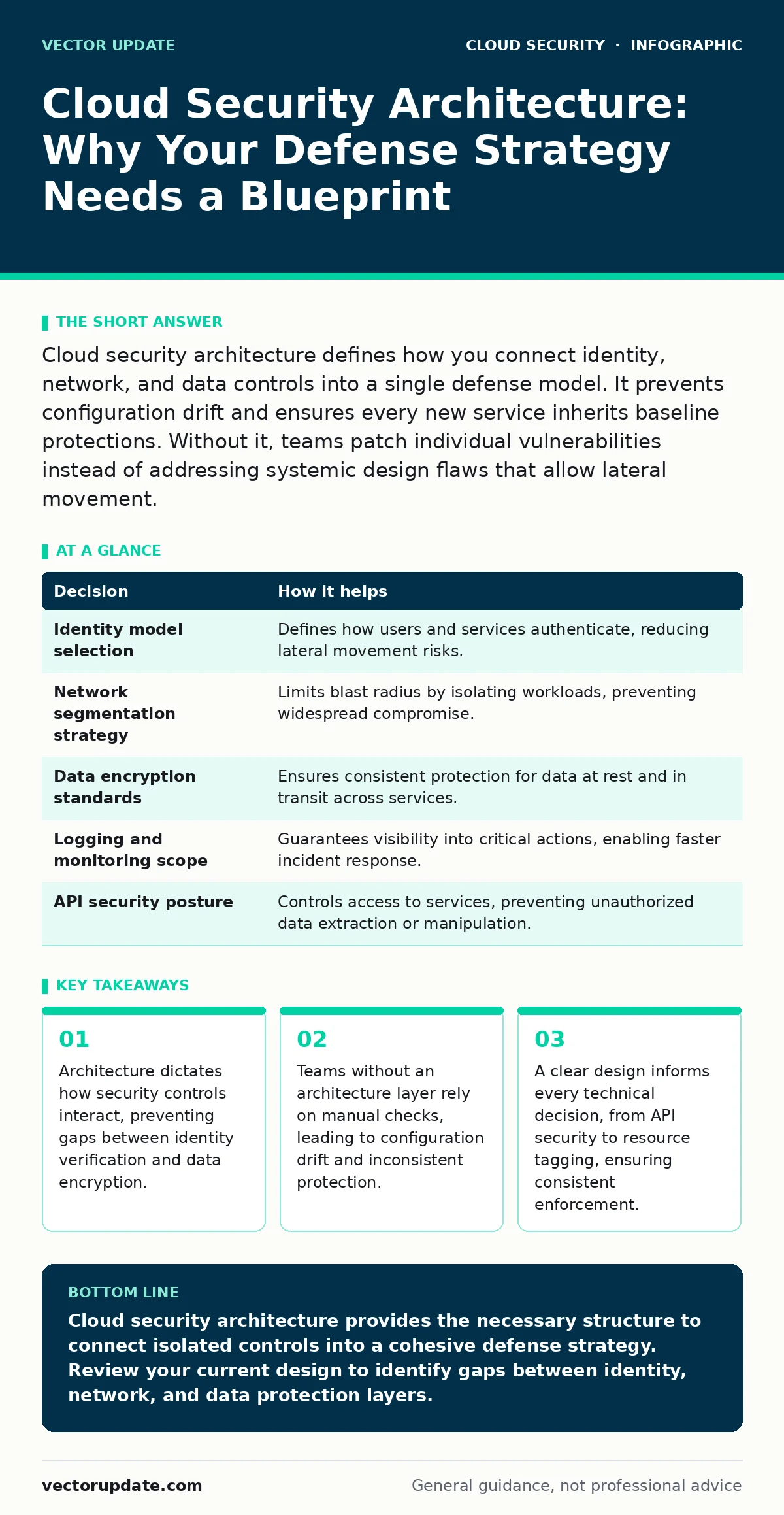
Cloud security architecture defines how you connect identity, network, and data controls into a single defense model. It prevents configuration drift and ensures every new service inherits baseline protections. Without it, teams patch individual vulnerabilities instead of addressing systemic design flaws that allow lateral movement.
Architecture defines your security posture
Cloud security architecture is the structured plan for how you protect data, identity, and infrastructure in the cloud. It is not a product you buy. It is a set of design decisions that dictate how controls interact. You must decide how identity verification flows into network access. You must decide how data encryption keys are managed relative to storage services. These decisions create the baseline for every workload you deploy. Without this structure, security becomes a series of disconnected tasks.
You might secure a database but leave the API that accesses it open. You might harden an instance but ignore the identity that controls it. Architecture ensures these pieces work together. It forces you to define the trust boundaries before you write code. This prevents the common mistake of assuming default settings are secure. Default settings often prioritize ease of use over protection. You must explicitly configure every boundary.
The cost of ad-hoc security
Imagine a team that deploys services without a reference architecture. They add security controls as they find vulnerabilities. They patch a misconfigured bucket today. They update a firewall rule tomorrow. This approach creates a patchwork defense. Each control exists in isolation. The team does not understand how the bucket policy interacts with the firewall. They do not see the full path an attacker could take. This leads to blind spots.
An attacker might bypass the firewall by exploiting a weak identity credential. The team never detected this because they treated identity and network as separate problems. This scenario highlights the hidden cost of reactive security. You spend more time investigating alerts because the context is missing. You cannot automate remediation because the rules are inconsistent. The system grows complex and brittle. Every new service requires unique manual checks. This slows down development and increases risk.
Decisions driven by design
A clear architecture informs specific technical decisions. It tells you which controls to prioritize and how to implement them. You cannot protect what you do not define. The architecture determines how you handle identity and access management. It dictates whether you use role-based access or attribute-based access. It influences your choice of encryption methods. It shapes how you monitor for threats.
Every decision flows from the initial design. If you design for perimeter defense, you will focus on firewalls. If you design for zero trust, you will focus on identity verification. The architecture makes this choice explicit. It prevents you from mixing incompatible models. It ensures that your monitoring tools can see the data they need. It guides your response to incidents. You know where to look because you designed the paths.
| Decision | How it helps |
|---|---|
| Identity model selection | Defines how users and services authenticate, reducing lateral movement risks. |
| Network segmentation strategy | Limits blast radius by isolating workloads, preventing widespread compromise. |
| Data encryption standards | Ensures consistent protection for data at rest and in transit across services. |
| Logging and monitoring scope | Guarantees visibility into critical actions, enabling faster incident response. |
| API security posture | Controls access to services, preventing unauthorized data extraction or manipulation. |
How teams use the framework
Teams use cloud security architecture as a living document. It is not a static policy. It evolves as the technology changes. Engineers reference it before deploying new services. They check if their design aligns with the established patterns. Security teams use it to audit configurations. They verify that actual deployments match the intended design. This reduces the gap between policy and practice. It enables automation.
You can write code that checks for architecture compliance. You can block deployments that violate the design. This shifts security left. You catch errors before they reach production. It also improves communication. Developers understand the security requirements because they are built into the design. Security teams understand the technical constraints because they helped define the architecture. This shared understanding reduces friction.
Integration with broader security
Cloud security architecture does not exist in a vacuum. It must connect with other security disciplines. You must consider cloud supply chain risks when designing your architecture. If you use third-party libraries, your architecture must include mechanisms to verify their integrity. You must address insecure cloud APIs by defining how access tokens are managed. Your architecture should enforce least privilege for every API call.
You must maintain a cloud asset inventory to ensure visibility. Without knowing what you have, you cannot protect it. Your architecture must include tagging and discovery mechanisms. You must also consider hybrid cloud security if you operate across multiple environments. The architecture must define how identity and network controls extend across boundaries. This ensures consistent protection regardless of where the workload runs.
See also: Detect Cloud Supply Chain Risks via Logs and Behavior · Difference Between Identity and Access Management Explained
The role of landing zones
A cloud landing zone provides the foundational structure for your architecture. It sets up the baseline environment. It includes identity services, logging, and network controls. Your architecture defines what goes into this zone. It specifies the security controls that must be present. It ensures that every new account or project inherits these controls. This prevents configuration drift.
You do not start from scratch each time. You build on a secure foundation. This accelerates deployment while maintaining security. It also simplifies compliance. You can audit the landing zone once. You know that all workloads inherit its protections. This reduces the burden on teams. They can focus on application logic rather than infrastructure security.
Continuous improvement and testing
Architecture requires validation. You must test it regularly. Cloud penetration testing helps identify gaps in your design. It reveals how attackers might bypass your controls. You use these findings to update the architecture. You refine your network segmentation. You tighten identity policies. You improve monitoring coverage. This cycle of test and refine keeps your defense effective. It adapts to new threats.
It incorporates lessons from real-world attacks. It ensures that your architecture remains relevant. You must also review your architecture when you adopt new technologies. New services introduce new risks. Your architecture must account for them. You must update your decisions. You must communicate changes to teams. This continuous process ensures that your security posture evolves with your business.
Managing complexity and trade-offs
Cloud security architecture involves trade-offs. You must balance security with usability. Strict controls can slow down development. You must find the right level of friction. Your architecture should automate as much as possible. Manual checks are prone to error. You must also balance centralization with autonomy. Centralized control ensures consistency. Autonomy allows teams to move fast.
Your architecture must define where each applies. You centralize identity and logging. You allow autonomy in application logic. This balance reduces friction while maintaining security. You must also manage complexity. Too many controls create confusion. Your architecture should be simple enough to understand. It should be detailed enough to implement. This clarity enables effective security.
Key takeaways
- Architecture dictates how security controls interact, preventing gaps between identity verification and data encryption.
- Teams without an architecture layer rely on manual checks, leading to configuration drift and inconsistent protection.
- A clear design informs every technical decision, from API security to resource tagging, ensuring consistent enforcement.
Cloud security architecture provides the necessary structure to connect isolated controls into a cohesive defense strategy. Review your current design to identify gaps between identity, network, and data protection layers.
Frequently asked questions
How does cloud security architecture differ from cloud landing zones?
Cloud security architecture is the strategic design of how controls interact. Cloud landing zones are the technical implementation of that design. The architecture defines the rules. The landing zone provides the infrastructure to enforce them. One is the plan. The other is the foundation.
Can cloud penetration testing replace a security architecture?
No. Penetration testing identifies specific vulnerabilities in your implementation. It does not define how your controls should work together. Architecture provides the blueprint for secure design. Testing validates that the design works. You need both to ensure comprehensive protection.
How do I handle cloud supply chain risks in my architecture?
Your architecture must include verification steps for third-party components. Define how you validate the integrity of libraries and images. Enforce these checks in your deployment pipeline. This ensures that you do not introduce vulnerabilities through external dependencies.
What happens if I skip defining an architecture?
You will likely face configuration drift and inconsistent security controls. Teams will make ad-hoc decisions that create blind spots. You will struggle to automate compliance. Incident response becomes slower because the system lacks a predictable structure.
How this guide was produced: written by the Vector Update editorial team with AI assistance, checked against the public references listed below, and reviewed when the facts change. See our editorial policy or report an error.