Detect Cloud Supply Chain Risks via Logs and Behavior
Attackers hide in legitimate build pipelines and third-party modules, leaving traces that standard security tools often ignore as normal operational noise.

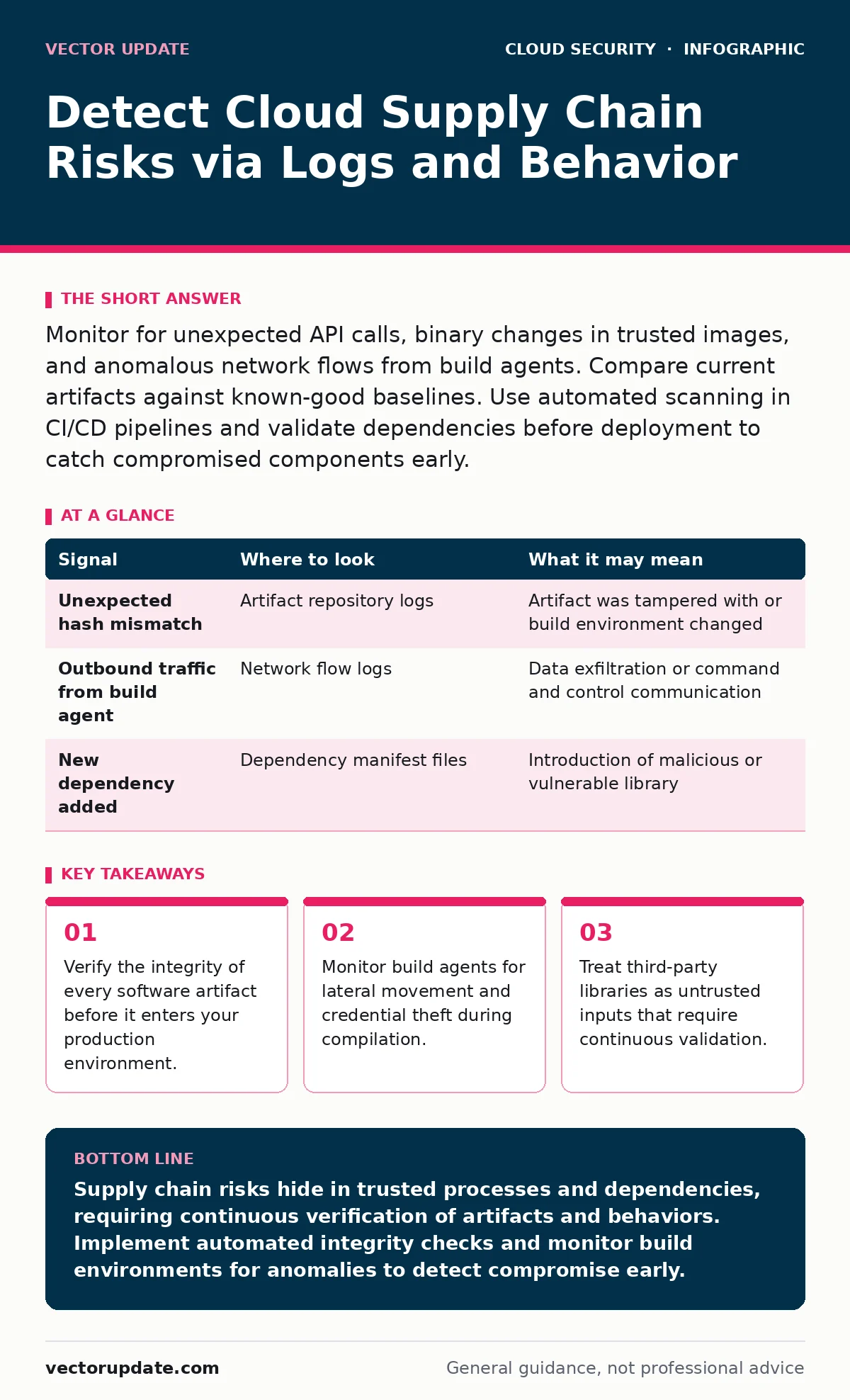
Monitor for unexpected API calls, binary changes in trusted images, and anomalous network flows from build agents. Compare current artifacts against known-good baselines. Use automated scanning in CI/CD pipelines and validate dependencies before deployment to catch compromised components early.
Identifying Compromised Build Agents
Build agents execute code on your infrastructure. Attackers target these systems to inject malicious code into legitimate software artifacts. You must monitor the behavior of these agents closely. Look for processes spawning unexpected child processes or accessing sensitive files they do not need. A build agent should only access source code and build tools. Any deviation suggests compromise.
Check for outbound connections to unknown IP addresses during the build phase. These connections may indicate data exfiltration of secrets or source code. The agent might also modify the build environment to persist the attack. This makes detection difficult if you only monitor the final output. You need to inspect the runtime behavior of the build process itself.
Analyzing Artifact Integrity Changes
Software artifacts change when developers update code. However, unexpected changes in binary files or configuration manifests indicate a supply chain attack. You should calculate and store hashes of every artifact after a successful build. Compare these hashes against new builds. A mismatch means the artifact was altered or the build environment changed.
Look for changes in dependencies that you did not approve. A sudden addition of a new library or a version bump in an existing one is a red flag. These changes often introduce backdoors or vulnerabilities. You must verify that all dependencies come from trusted sources. Unsigned or improperly signed artifacts should be rejected automatically. This prevents malicious code from entering your deployment pipeline.
| Signal | Where to look | What it may mean |
|---|---|---|
| Unexpected hash mismatch | Artifact repository logs | Artifact was tampered with or build environment changed |
| Outbound traffic from build agent | Network flow logs | Data exfiltration or command and control communication |
| New dependency added | Dependency manifest files | Introduction of malicious or vulnerable library |
Monitoring CI/CD Pipeline Execution
Continuous integration and delivery pipelines automate software deployment. Attackers modify pipeline configurations to run malicious commands. You must audit pipeline execution logs for unauthorized changes. Look for new steps added to the pipeline or changes to existing steps. These changes might install malware or steal credentials.
Check for pipelines running from unapproved repositories or branches. A pipeline triggered by an unknown user or webhook is suspicious. The execution time of a pipeline should also be consistent. Significant delays may indicate the execution of hidden tasks. You should restrict who can modify pipeline configurations. This limits the attack surface and reduces the risk of configuration drift.
Detecting Anomalous Network Behavior
Compromised supply chain components often communicate with external servers. You must monitor network traffic for unusual patterns. Look for DNS queries to newly registered domains. These domains often host command and control servers. Check for connections to IP addresses in countries where you have no business presence. This indicates data exfiltration or malicious command execution.
Monitor for large data transfers from build systems. These transfers may contain stolen source code or credentials. You should also look for connections on non-standard ports. Legitimate software updates usually use standard ports like 443. Deviations from this norm require immediate investigation. Network segmentation can help contain these threats by limiting access.
Validating Third-Party Dependencies
Third-party libraries are common entry points for supply chain attacks. You must validate every dependency before deployment. Check the origin of each library and verify its signature. Look for libraries that have been abandoned or have no recent updates. These libraries are more likely to contain unpatched vulnerabilities.
Monitor for dependencies that have been taken over by malicious actors. This is known as a typosquatting attack where a similar name is used. You should use automated tools to scan dependencies for known vulnerabilities. These tools compare your dependencies against public vulnerability databases. Regular updates and strict version pinning reduce the risk of unexpected changes.
See also: Cloud Penetration Testing Misunderstandings Corrected · Cloud Firewall Mistakes That Expose Your Infrastructure
Auditing Identity and Access Permissions
Compromised credentials allow attackers to move laterally within your cloud environment. You must audit identity and access management policies regularly. Look for users or services with excessive permissions. These accounts are high-value targets for attackers. Check for unused accounts and disable them immediately. Monitor for login attempts from unusual locations or at odd times.
These attempts may indicate credential theft. You should enforce multi-factor authentication for all privileged accounts. This adds an extra layer of security against stolen credentials. Regularly rotate access keys and secrets to limit the impact of a breach. The guide on [identity and access management] provides detailed steps for implementing these controls.
Overcoming Common Blind Spots
Supply chain attacks often hide in plain sight. One common blind spot is the assumption that private repositories are safe. Attackers can compromise the systems that access these repositories. Another blind spot is ignoring the metadata of software packages. Metadata can contain malicious scripts that execute during installation. You must inspect metadata for unexpected fields or values. A third blind spot is relying solely on static analysis. Static analysis cannot detect runtime behaviors or network communications.
You need dynamic analysis to catch these threats. The guide on [cloud logging and monitoring] explains how to set up comprehensive logging. The guide on [cloud asset inventory] helps you track all assets. The guide on [cloud penetration testing] identifies hidden vulnerabilities. The guide on [insecure cloud APIs] highlights API risks. The guide on [cloud landing zones] provides secure baseline configurations. The guide on [cloud security architecture] offers design principles. The guide on [open security groups] warns against excessive network access.
Key takeaways
- Verify the integrity of every software artifact before it enters your production environment.
- Monitor build agents for lateral movement and credential theft during compilation.
- Treat third-party libraries as untrusted inputs that require continuous validation.
Supply chain risks hide in trusted processes and dependencies, requiring continuous verification of artifacts and behaviors. Implement automated integrity checks and monitor build environments for anomalies to detect compromise early.
Frequently asked questions
How do I verify the integrity of a software artifact?
Calculate a cryptographic hash of the artifact and compare it against a known-good baseline stored in a secure repository.
What is a typosquatting attack in the context of supply chain security?
It is an attack where a malicious actor registers a package name similar to a legitimate one to trick users into installing malware.
Why is monitoring build agents important for supply chain security?
Build agents execute code and can be compromised to inject malicious code into legitimate software artifacts before deployment.
Can static analysis detect all supply chain attacks?
No, static analysis cannot detect runtime behaviors, network communications, or attacks that rely on dynamic execution environments.
How this guide was produced: written by the Vector Update editorial team with AI assistance, checked against the public references listed below, and reviewed when the facts change. See our editorial policy or report an error.