Hybrid Cloud Security Architecture: Design Controls That Follow Data
Hybrid cloud security architecture fails when teams treat the public cloud as a separate network rather than an extension of the on-premises identity perimeter.

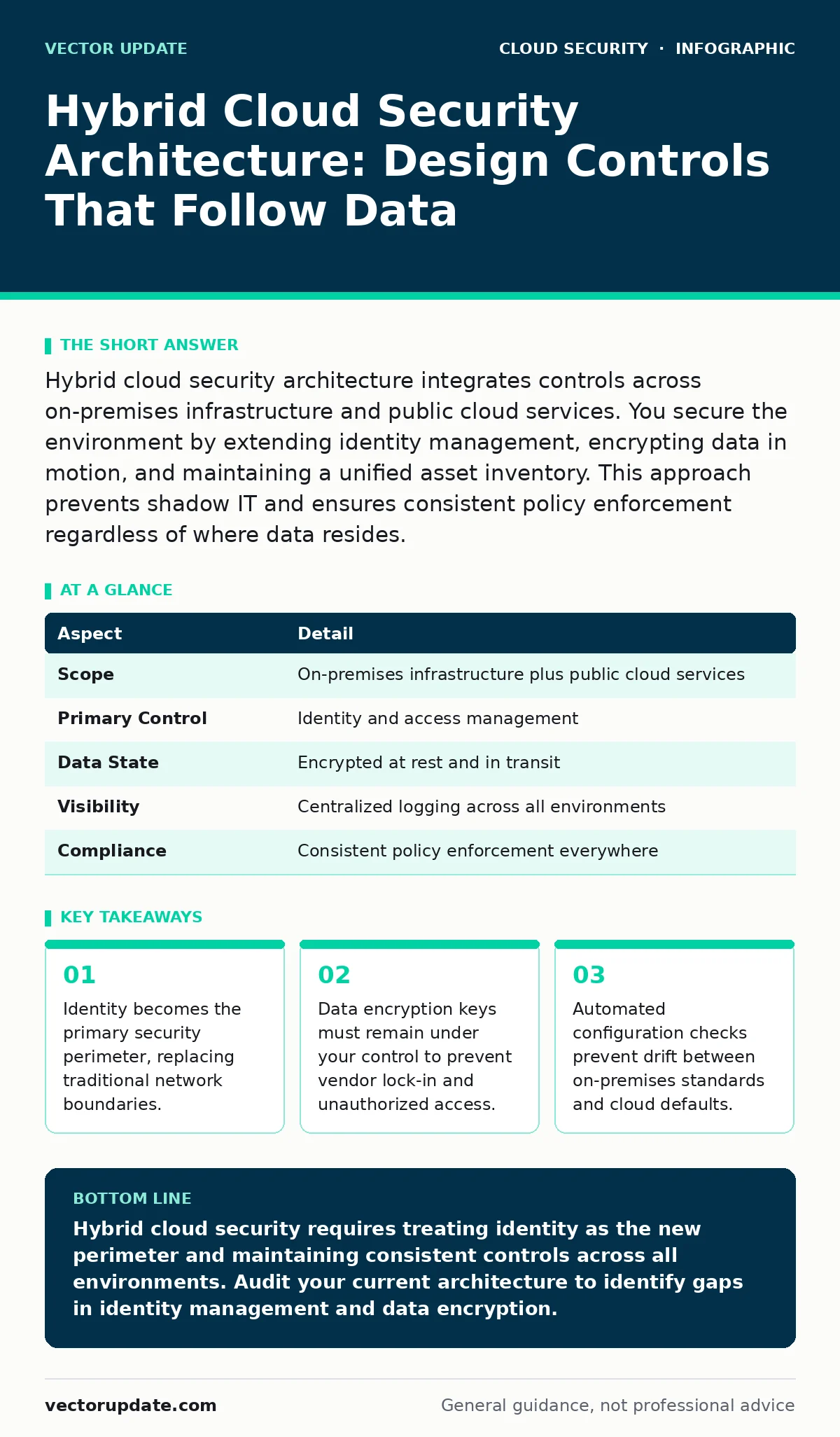
Hybrid cloud security architecture integrates controls across on-premises infrastructure and public cloud services. You secure the environment by extending identity management, encrypting data in motion, and maintaining a unified asset inventory. This approach prevents shadow IT and ensures consistent policy enforcement regardless of where data resides.
The Bridge Analogy
Imagine a private island connected to the mainland by a bridge. The island has strict guards at the gate. The mainland has open streets. If you only guard the island gate, anyone can walk across the bridge and enter the island from the other side. Hybrid cloud security works the same way. Your on-premises data center is the island. The public cloud is the mainland. The connection between them is the bridge. You must secure the bridge and the mainland entry points, not just the island gate.
| Aspect | Detail |
|---|---|
| Scope | On-premises infrastructure plus public cloud services |
| Primary Control | Identity and access management |
| Data State | Encrypted at rest and in transit |
| Visibility | Centralized logging across all environments |
| Compliance | Consistent policy enforcement everywhere |
What Is Hybrid Cloud Security Architecture?
Hybrid cloud security architecture is the framework of policies, tools, and processes that protect data and applications running across both private infrastructure and public cloud platforms. It does not treat the cloud as a remote office. It treats the cloud as a native part of the organization's computing environment. This distinction matters because traditional firewalls cannot inspect traffic inside the cloud provider's network. You must shift from perimeter defense to identity-centric controls.
The architecture relies on zero trust principles. Zero trust is a security model that requires verification for every person and device trying to access resources. It assumes breach and verifies explicitly. This model works better in hybrid environments because the network perimeter is porous. Users access applications from anywhere. Devices connect from any network. The architecture must authenticate the user and the device before granting access to data.
How The Controls Work Together
Security controls in a hybrid environment must communicate. An identity provider on-premises must sync with cloud directory services. This sync ensures that when an employee leaves, their access revokes everywhere. If the sync fails, the former employee retains cloud access. This creates a persistent risk.
Network segmentation also spans both environments. You define security groups in the cloud that mirror VLANs in the data center. This mirroring allows you to apply consistent rules. For example, web servers talk to application servers, but not to databases. This rule applies whether the database is on a local rack or in a cloud managed service.
Data protection requires key management. You generate encryption keys on-premises or in a dedicated key management service. You store these keys separately from the encrypted data. When data moves to the cloud, it remains encrypted. The cloud provider cannot read the data because they do not hold the keys. This separation ensures you retain control over sensitive information.
Who This Affects
Every organization using public cloud services while maintaining on-premises servers faces these risks. This includes enterprises with legacy applications that cannot move to the cloud. It also includes startups that began in the cloud but added on-premises hardware for compliance. The risk is not limited by company size. It is limited by complexity.
System administrators manage the technical implementation. They configure firewalls, manage certificates, and monitor logs. Security architects design the policies. They define who can access what and when. Compliance officers ensure the architecture meets regulatory requirements. They verify that data stays within required geographic boundaries. All three roles must collaborate. Silos between them create gaps.
The cloud provider shares responsibility. They secure the physical hardware and the hypervisor. You secure the guest operating system, applications, and data. This shared responsibility model often causes confusion. Teams assume the provider handles security. The provider assumes the team handles security. This assumption leads to misconfigurations.
Common Mistakes In Design
Teams often design hybrid security as two separate systems. They build a secure on-premises network. They build a secure cloud landing zone. They connect them with a VPN. They forget to align the policies. This creates a weakest link. An attacker exploits the weaker side to reach the stronger side.
Another mistake is relying on network location for security. Teams grant access to anyone inside the corporate VPN. This is outdated. VPNs are vulnerable to credential theft. If an attacker steals a VPN password, they get access to everything. You must verify identity for every request. You must check the device health. You must enforce least privilege access.
Teams also neglect asset inventory. They do not know what assets exist in the cloud. They assume the cloud provider tracks everything. The provider tracks infrastructure, not your applications. You must maintain a cloud asset inventory. This inventory lists every server, storage bucket, and database. It maps them to owners. Without this map, you cannot secure what you do not see.
See also: Cloud Asset Inventory Mistakes That Leave Data Exposed · Open Security Groups: 6 Myths Blocking Your Cloud Defense
Aligning With Related Frameworks
A strong hybrid cloud security architecture integrates with broader security practices. You cannot secure the cloud in isolation. You must connect it to your existing controls.
Identity and access management serves as the foundation. It provides single sign-on and multi-factor authentication. It ensures consistent identity policies across environments. Without it, users have multiple passwords. They share credentials. This increases the risk of account takeover.
Cloud logging and monitoring provides visibility. It collects logs from on-premises servers and cloud services. It sends them to a central security information and event management system. This centralization allows you to correlate events. You can detect an attack that starts on-premises and moves to the cloud.
Insecure cloud APIs represent a significant attack surface. Cloud services expose APIs for management and data access. These APIs must be authenticated and rate-limited. You must audit API usage regularly. You must revoke unused API keys. This prevents attackers from exploiting exposed endpoints.
Cloud supply chain risks affect hybrid environments. You use third-party software and libraries in both environments. You must verify the integrity of these components. You must scan for known vulnerabilities. You must ensure updates are applied consistently. A vulnerable library in the cloud can compromise on-premises data.
Implementing The Architecture
Start with identity. Deploy a federated identity provider. Connect it to all cloud services. Enforce multi-factor authentication for all users. This step reduces the risk of credential theft. It provides a single point of control.
Next, secure the data. Encrypt all sensitive data at rest. Use customer-managed keys. Store these keys in a separate system. Encrypt data in transit using TLS. Verify certificates. This prevents eavesdropping and tampering.
Then, automate compliance. Use infrastructure as code to define security controls. Apply these controls consistently. Use automated tools to check for drift. Alert when configurations deviate from the baseline. This ensures the environment remains secure over time.
Finally, test the architecture. Perform penetration testing. Simulate attacks from both on-premises and cloud perspectives. Identify gaps in visibility and control. Fix these gaps before attackers find them. This proactive approach reduces risk.
Key takeaways
- Identity becomes the primary security perimeter, replacing traditional network boundaries.
- Data encryption keys must remain under your control to prevent vendor lock-in and unauthorized access.
- Automated configuration checks prevent drift between on-premises standards and cloud defaults.
Hybrid cloud security requires treating identity as the new perimeter and maintaining consistent controls across all environments. Audit your current architecture to identify gaps in identity management and data encryption.
Frequently asked questions
How do I handle legacy applications in a hybrid cloud?
Wrap legacy applications in an API gateway. Enforce authentication and authorization at the gateway level. This adds security without modifying the application code.
Can I use the same firewall rules for on-premises and cloud?
You can apply similar security policies, but the implementation differs. Use security groups in the cloud and ACLs on-premises. Map the rules to ensure consistency.
What is the biggest risk in hybrid cloud security?
Misconfiguration is the biggest risk. Teams often leave cloud resources exposed due to lack of visibility. Automated compliance checks help prevent this.
How do I monitor hybrid cloud security?
Centralize logs from all environments. Use a SIEM tool to correlate events. Set alerts for anomalous behavior. This provides a unified view of security posture.
How this guide was produced: written by the Vector Update editorial team with AI assistance, checked against the public references listed below, and reviewed when the facts change. See our editorial policy or report an error.