Example of Digital Privacy: How Control Works in Practice
Digital privacy is not secrecy but the right to control who accesses your data, when they access it, and for what specific purpose.

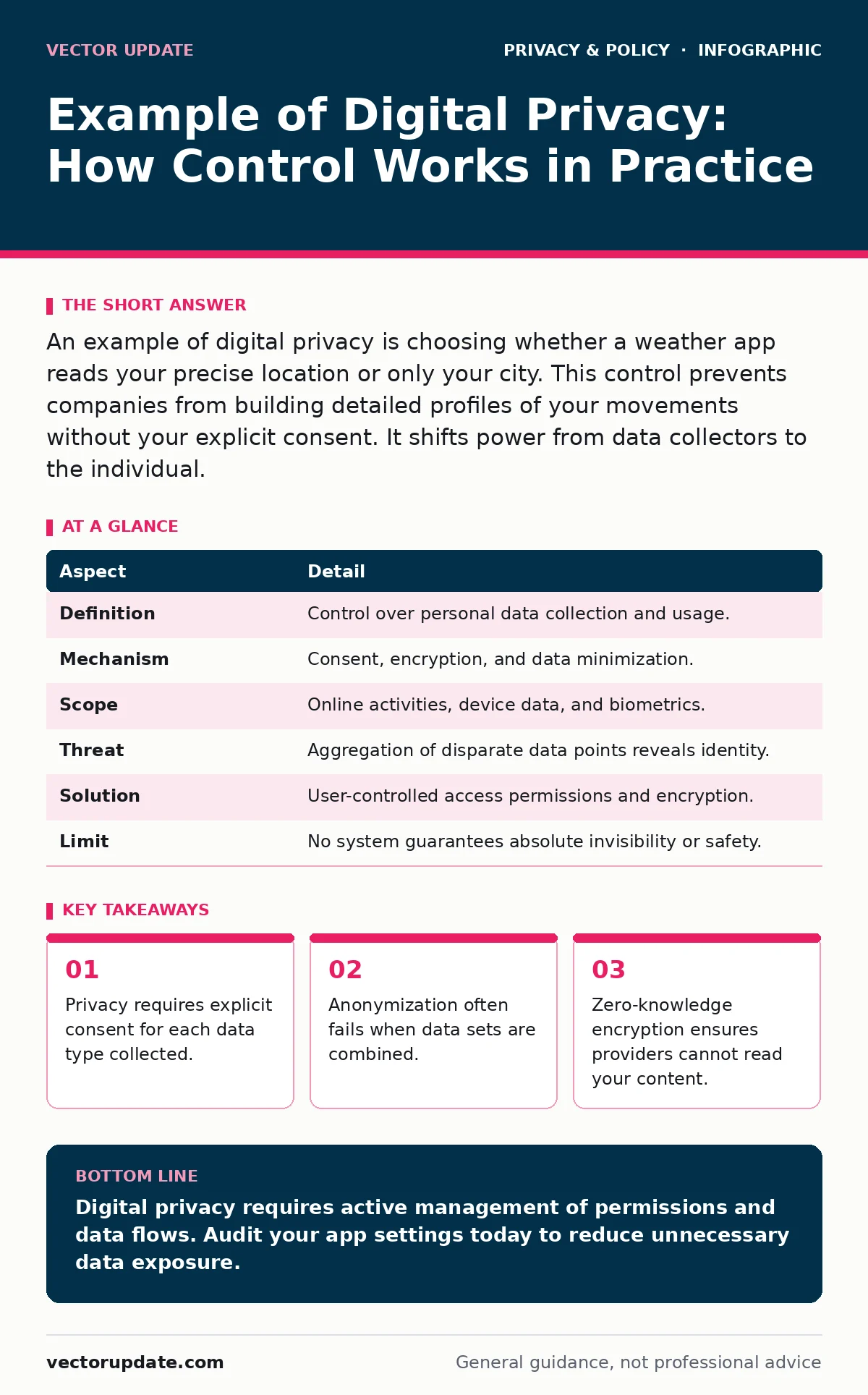
An example of digital privacy is choosing whether a weather app reads your precise location or only your city. This control prevents companies from building detailed profiles of your movements without your explicit consent. It shifts power from data collectors to the individual.
What Is Digital Privacy
Digital privacy is the right of an individual to determine how their personal information is collected, used, and shared. It is not about hiding facts but about controlling the flow of data. You decide which details remain private and which become public. This control prevents unauthorized profiling and surveillance.
Imagine you leave your house keys on a table. Anyone can take them. Digital privacy is locking those keys in a box and giving copies only to trusted people. You hold the master key. This analogy clarifies that privacy is an active choice, not a passive state.
| Aspect | Detail |
|---|---|
| Definition | Control over personal data collection and usage. |
| Mechanism | Consent, encryption, and data minimization. |
| Scope | Online activities, device data, and biometrics. |
| Threat | Aggregation of disparate data points reveals identity. |
| Solution | User-controlled access permissions and encryption. |
| Limit | No system guarantees absolute invisibility or safety. |
Example of Digital Privacy
An example of digital privacy is configuring a photo app to upload images only to a private album, not to a public search index. This setting prevents strangers from finding your face through reverse image searches. It keeps your visual identity restricted to your chosen audience. You retain ownership of the data.
This scenario demonstrates granular control. You allow necessary data flow for service delivery while blocking unnecessary exposure. It shows that privacy is not binary. You can share some data while withholding other types. This balance is the core of modern digital rights.
How Privacy Controls Work
Privacy controls rely on technical and legal mechanisms. Encryption scrambles data so only authorized parties can read it. Zero-knowledge encryption ensures that even the service provider cannot see your content. The provider holds the encrypted blob but lacks the decryption key.
Consent management requires clear user interfaces. You must see what data is requested and why. Vague terms of service violate this principle. Clear labels allow you to reject non-essential data collection. This rejection should not break the core service functionality.
Data minimization reduces risk by collecting only what is needed. If a flashlight app asks for your contacts, it violates this principle. You can deny such requests. This denial prevents data hoarding by applications that have no legitimate need for the information.
Who Privacy Policies Affect
Every digital user is affected by privacy policies. These documents dictate how your data is handled. They often favor the collector, not the user. You must read them to understand your exposure. Most people skip this step, accepting default settings that maximize data extraction.
Service providers are bound by these policies. They face legal penalties if they misuse data. However, enforcement varies by region. Some jurisdictions have strong protections, while others offer little recourse. You must know your local rights to act effectively.
Third-party advertisers are also affected. They rely on data brokers to build profiles. Privacy controls disrupt this chain. When you block tracking, advertisers lose precision. This loss reduces the effectiveness of targeted ads but increases your safety.
What People Usually Get Wrong
Many believe deleting an account removes their data. This belief is false. Companies often retain backups or aggregated data. They may sell anonymized patterns derived from your history. Anonymization is rarely perfect. Re-identification attacks can link anonymous data back to you.
Differential privacy adds noise to data sets to protect individuals. It is not the same as simple anonymization. It provides mathematical guarantees against re-identification. However, it reduces data accuracy. You trade precision for safety. Understanding this trade-off is critical for informed decisions.
Another misconception is that private browsing hides your activity from your ISP. It only clears your local history. Your Internet Service Provider still sees every request you make. ISP tracking remains a significant threat. You need additional tools to mask your traffic from them.
See also: How Does Encrypted Email Work: The Mechanics of Secure Messaging · Biometric Data Definition: How Identity Templates Create Permanent Risk
Practical Steps for Protection
Start by auditing app permissions. Check which apps access your microphone, camera, and location. Revoke access for apps that do not need these sensors. A keyboard app does not need your location. A game does not need your contacts. Each permission revocation reduces your attack surface.
Use end-to-end encryption for sensitive communications. This ensures only you and your recipient can read messages. Encrypted email services provide this protection for correspondence. They prevent intermediaries from scanning your content. This step is vital for protecting confidential information.
Consider using Tor Browser for sensitive research. It routes your traffic through multiple relays, masking your origin. It protects against network-level surveillance. However, it slows down connection speeds. You accept this performance hit in exchange for anonymity.
Long-Term Privacy Habits
Privacy is an ongoing process, not a one-time setup. New apps and services emerge constantly. Each introduces new risks. You must stay informed about changes in terms of service. Subscribe to security newsletters from trusted sources. This keeps you updated on emerging threats.
Biometric data poses unique risks. Fingerprints and facial scans cannot be changed like passwords. If this data is leaked, you cannot reset it. Be cautious about storing biometrics in the cloud. Use local storage on your device whenever possible. This limits the exposure of your unique identifiers.
Parental controls can teach children about digital boundaries. They help manage exposure to inappropriate content. However, they also model privacy behaviors. Use them transparently. Explain why certain restrictions exist. This builds trust and teaches responsible digital citizenship.
Key takeaways
- Privacy requires explicit consent for each data type collected.
- Anonymization often fails when data sets are combined.
- Zero-knowledge encryption ensures providers cannot read your content.
Digital privacy requires active management of permissions and data flows. Audit your app settings today to reduce unnecessary data exposure.
Frequently asked questions
Does deleting a browser history remove my data from servers?
No. Deleting local history only clears records on your device. Servers retain logs and analytics data. You must contact providers to request data deletion.
Can I be tracked if I use a VPN?
A VPN hides your IP address from websites, but your VPN provider can still see your traffic. Trust in the provider is critical. Choose one with a strict no-logs policy.
Is anonymization enough to protect my identity?
Anonymization often fails when combined with other data sets. Re-identification techniques can strip away anonymity. Use differential privacy for stronger guarantees.
How do I know if an app is selling my data?
Check the privacy policy for sections on data sharing and third-party partners. Look for language about advertising partners. If it is vague, assume data is being sold.
How this guide was produced: written by the Vector Update editorial team with AI assistance, checked against the public references listed below, and reviewed when the facts change. See our editorial policy or report an error.