Anonymisation or Anonymization: How to Strip Identifiers Safely
Most data labeled as anonymous can be re-identified by combining it with public records, making true privacy require statistical noise rather than simple deletion.

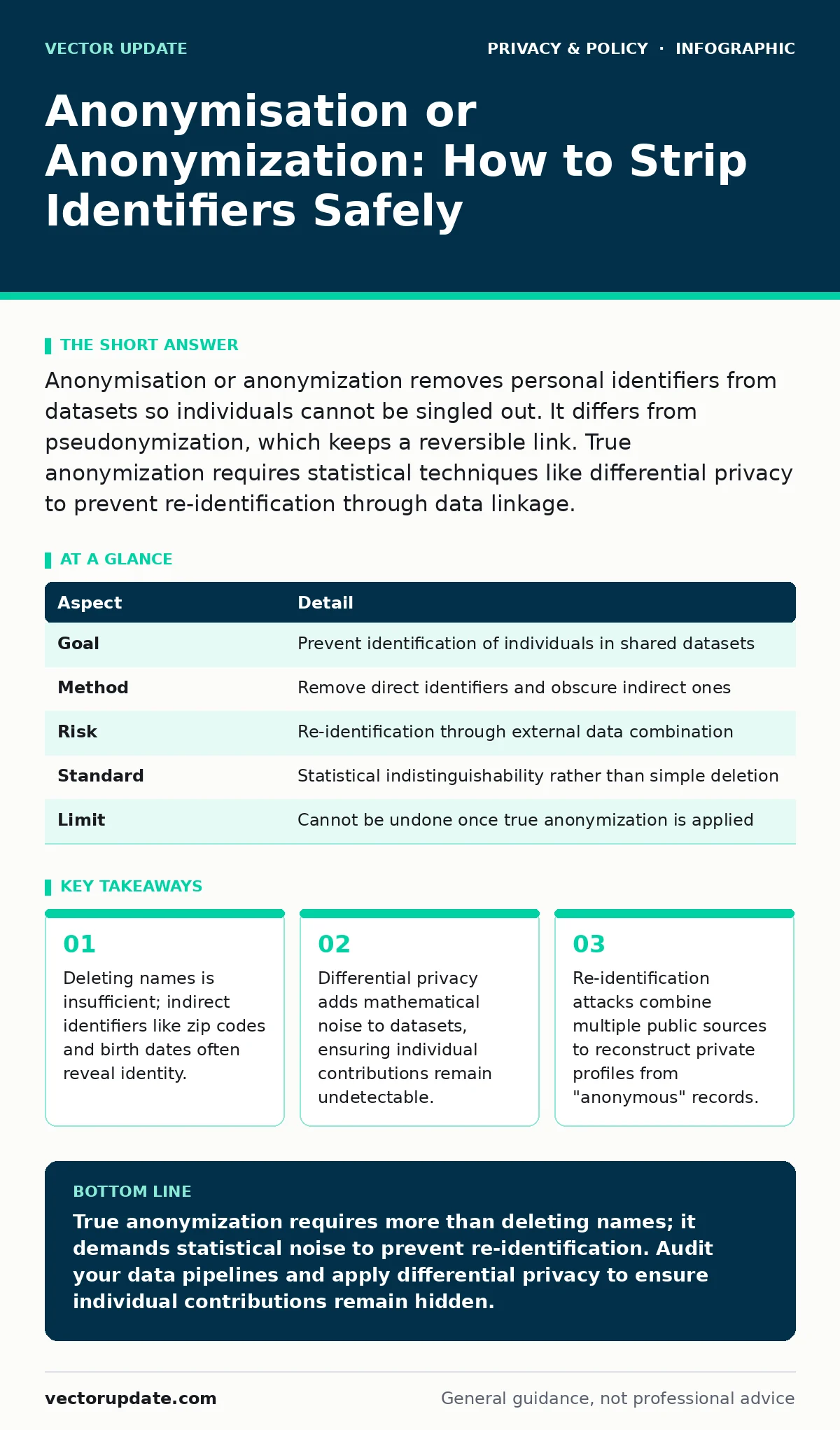
Anonymisation or anonymization removes personal identifiers from datasets so individuals cannot be singled out. It differs from pseudonymization, which keeps a reversible link. True anonymization requires statistical techniques like differential privacy to prevent re-identification through data linkage.
Why Anonymisation or Anonymization Matters for Data Safety
Imagine a library catalog that lists every book borrowed by every patron, but removes the names. If you know your neighbor only reads obscure technical manuals, you can identify their borrowing history by matching the titles. This is the core problem with data privacy. Anonymisation or anonymization aims to break the link between data points and the specific humans who generated them. It allows organizations to share useful information without exposing private details.
The process affects anyone whose digital behavior is recorded. System administrators manage these datasets daily. Users provide the raw material through clicks, purchases, and location traces. The goal is to enable analysis while protecting individual privacy. This balance is difficult because data is rarely isolated. Every record exists in a context that can be cross-referenced.
| Aspect | Detail |
|---|---|
| Goal | Prevent identification of individuals in shared datasets |
| Method | Remove direct identifiers and obscure indirect ones |
| Risk | Re-identification through external data combination |
| Standard | Statistical indistinguishability rather than simple deletion |
| Limit | Cannot be undone once true anonymization is applied |
How De-identification Mechanisms Actually Work
The simplest approach removes direct identifiers like names, email addresses, and social security numbers. This is often called de-identification. It is a necessary first step but rarely sufficient. An attacker can still link the remaining data to a specific person using indirect identifiers. These include age, gender, zip code, and job title.
K-anonymity is a common technique. It ensures that each record in a dataset is indistinguishable from at least k-1 other records. If k is 5, every person in the data looks like at least 4 others. This prevents singling out an individual based on quasi-identifiers. However, it does not protect against attribute disclosure. If all 5 people in a group have the same rare disease, an attacker learns that the target has that disease.
Differential privacy offers stronger protection. It adds random noise to query results or the dataset itself. The noise is calibrated so that the presence or absence of any single individual does not significantly change the output. This provides a mathematical guarantee of privacy. It allows accurate statistical analysis while hiding individual contributions.
What People Usually Get Wrong About Privacy
Many assume that removing names makes data safe. This is a persistent misconception. Public records, social media posts, and voter rolls contain enough information to re-identify most people. This combination appears frequently in "anonymous" datasets.
Another error is confusing anonymization with pseudonymization. Pseudonymization replaces identifiers with artificial codes. The original data can be restored using a key. This is useful for internal processing but does not remove privacy risk. If the key is compromised, the data is exposed. Anonymization should be irreversible. Once data is truly anonymized, no key exists to revert it.
Some believe that aggregating data eliminates risk. Aggregation reduces granularity but does not remove it. If a group is small, individual behavior can still be inferred. For example, if a company reports that 3 employees in a small department take sick leave, and only one person was absent that day, that person is identified.
The Hidden Cost of True Anonymity
Achieving strong anonymization has a trade-off. The more privacy you protect, the less precise the data becomes. Differential privacy requires adding noise. Too much noise makes the data useless for analysis. Too little noise fails to protect privacy. Finding the right balance requires careful statistical planning.
Organizations often underfund this process. They hire data scientists to clean data but not to model re-identification risks. This leads to false confidence. Data is released with the label "anonymized" but lacks the statistical rigor to prevent linkage. The cost of a breach then includes not just financial loss, but loss of trust.
Reducing your digital footprint is a related strategy. It limits the amount of data available for re-identification. If there is less external data, it is harder to link back to anonymous records. This is a defensive measure for individuals, complementing the technical measures used by data holders.
Who Is Affected by Data Linkage Attacks
Anyone who uses services that collect data is affected. This includes users of encrypted email, VPNs, and Tor Browser. These tools protect data in transit but do not anonymize the data once it reaches the server. If the server logs are shared or leaked, they can be analyzed.
Biometric data presents unique challenges. Fingerprints and facial recognition data are inherently identifying. They cannot be changed like passwords. Anonymizing biometric data requires converting it into a template that cannot be reversed to the original image. This is technically difficult and often imperfect.
Digital privacy rights frameworks often mandate anonymization. However, the legal definition of anonymous data varies. Some laws accept pseudonymization as sufficient. This creates a gap between legal compliance and technical safety. Administrators must understand both the legal requirements and the technical realities.
See also: Biometric Data Definition: How Identity Templates Create Permanent Risk
What You Can Do About It
System administrators should audit their data pipelines. Identify all direct and indirect identifiers. Remove direct identifiers first. Then apply k-anonymity or differential privacy to indirect identifiers. Test the data against public sources to see if re-identification is possible.
Use standard tools and frameworks. Do not roll your own anonymization algorithms. Established libraries implement differential privacy correctly. They handle the complex mathematics of noise calibration. Custom scripts often introduce biases or fail to add enough noise.
For individuals, limiting data sharing is the best defense. Use parental controls to restrict data collection for children. Be cautious with apps that request location or contact access. The less data you generate, the harder it is for anyone to re-identify you in aggregated datasets.
The Role of Standards and Best Practices
Open standards help ensure consistency. Frameworks like the NIST Privacy Framework provide guidance on data handling. They define terms and processes for de-identification. Following these standards helps organizations avoid common pitfalls.
Regular training is necessary. Staff must understand the difference between anonymization and pseudonymization. They must know the risks of data linkage. This knowledge prevents accidental exposure of sensitive information.
Collaboration between privacy experts and data scientists is key. Privacy experts define the risk tolerance. Data scientists implement the technical solutions. Together, they can create datasets that are both useful and safe.
Key takeaways
- Deleting names is insufficient; indirect identifiers like zip codes and birth dates often reveal identity.
- Differential privacy adds mathematical noise to datasets, ensuring individual contributions remain undetectable.
- Re-identification attacks combine multiple public sources to reconstruct private profiles from "anonymous" records.
True anonymization requires more than deleting names; it demands statistical noise to prevent re-identification. Audit your data pipelines and apply differential privacy to ensure individual contributions remain hidden.
Frequently asked questions
Is anonymization the same as encryption?
No. Encryption scrambles data that can be decrypted with a key. Anonymization removes or alters data so it cannot be linked to an individual, and the process is irreversible.
Can I anonymize data myself with a script?
Simple scripts that remove names are insufficient. You need statistical methods like differential privacy to prevent re-identification through indirect identifiers. Use established libraries.
Does GDPR require anonymization?
GDPR encourages anonymization because anonymous data is outside the scope of the regulation. However, the standard for anonymity is high
How this guide was produced: written by the Vector Update editorial team with AI assistance, checked against the public references listed below, and reviewed when the facts change. See our editorial policy or report an error.